Showing posts with label background. Show all posts

Thursday, August 8, 2019

Three vintage Phils for my second blogiversary

I just caught my blogiversary in time to make a post for it.  Today is two years blogging, although the blog posts come infrequently these days.  In a sense I write for a living; I'm a math professor, and I mainly write research papers.  There's a lot of other writing, too, though, which in various forms involves either advocating for my own research (like in grant proposals) or evaluating other people's research (like in reports on other people's papers, theses, grant proposals, and tenure cases).  Much of this involves responsibility to other people -- if I don't work on writing a paper, I might be letting a coauthor down.  Which is all to say that writing on a blog sometimes has to take a back seat.  But I try to get back into it after I've been away for a while, and I see that it's been more than a month since my last blog post.  So as usual when I've been away, I'll say now that I want to get back to it, and I'll start now with three vintage Phillies.
1961 Topps Dallas Green
Dallas Green was a hero to us kids in the greater Philly area in the early 80s, although perhaps not in the same ways as Schmidt and Carlton, or even Bowa, Trillo, Bowa, Boone, Maddox, or McGraw.  But Dallas Green was the manager who delivered the first World Series for the Phillies.  He didn't hang around much after that, and was soon off to the front office of the Cubs.  But he was in Philadelphia long enough to deliver.  His 1980 Topps Burger King card has always had a place in my binder.  I decided to get a card of him as a player; he didn't only play with the Phillies, but it looks like all his cards have him with the Phils.  He was only briefly with the Senators and the Mets.  Green also is another special collection of mine, which is of Delawareans who made it to MLB.
1961 Topps Clay Dalrymple
Another 1961 Phillie is catcher Clay Dalrymple.  He played with the Phillies from 1960-1968 and with the Orioles from 1969-1971.  Wikipedia claims Dalrymple is second only to Campanella at percentage of throwing out baserunners attempting to steal; Baseball Reference puts Dalrymple at 30th place all-time.  In any case, he was a good defensive catcher for a number of years.  I wanted to pick up a card of Dalrymple for a specific reason, which is that I have his autograph.  The autograph is on a Phillies hat, and Dad and I got it at one of the many games we went to back in the late 80s/early 90s.  I don't remember exactly how it worked, but I think we gave some money to charity, and got the hat as a prize?  I don't know if it was a raffle situation or a grab bag or something.  But however it worked, I now have a card to go with the autographed cap.
1967 Topps Rick Wise
Dalrymple wasn't the only autographed cap we got, either.  I also have a Rick Wise.  Wise was a solid pitcher but is most famous for being traded for Steve Carlton, of course.  I had some Rick Wise cards in the 1972 set that I'm building, but wanted another outside of that set for my main binder.  So this 1967 will do nicely.

Thanks, as always, for reading!

Friday, December 28, 2018

The Story of Bobby Shantz

Today's a bit of a special post; today is the 6th anniversary of my dad's death.  Dad died on his and Mom's wedding anniversary, and today would have been their 50th, if he had lived.  This post is about Bobby Shantz, but we'll get there by starting with some background on my dad.

Dad was born in 1945 in Wilmington, Delaware, which is quite close to Philadelphia.  His father died in 1951 when he was five years old, almost six.  He went to live in Philadelphia at a boarding school for "orphans," which in practice at the time meant fatherless boys.  His mother had a home near Wilmington and he only saw her occasionally, until she died when he was 13, making him a true orphan.  Her home passed on to one of Dad's aunts.  That aunt lived there for about thirty years, until she got sick and moved in with her daughter circa 1990.  When that happened, Dad was invited over to go through some of the things in the basement.  He brought home some stuff, I think including an old model train set, but mainly a few boxes of his father's books.  He bought some bookshelves and put his father's books in the living room.  They stayed there, largely untouched I think, for a couple of decades, I would say.

Now that Dad is gone, Mom is staying in the house but has in mind that she might sell eventually.  She wants to be ready if she does sell, and has been getting rid of some old things.  She gave most of Dad's father's books away, but saved one for me: The Story of Bobby Shantz.  But it couldn't have been his father's book since his father died in 1951 and the book was published in 1953.  I think this must have actually been Dad's book when he was little, and even though he lived at the orphanage/boarding school, maybe his mother gave it to him when he was home sometime.  Anyway, so much is lost to history.  But for sure Bobby Shantz was a Philadelphia star, Dad was a little kid in and near Philadelphia back then, and this book came out of his mother's house and eventually made its way to me many years later.
Front cover.
Back cover.
Night Owl had a great post on Bobby Shantz earlier this month.  He featured the 1956 Topps card, which I've since gone and picked up in my COMC account.  This book, the Story of Bobby Shantz, was published just a bit earlier, in 1953, coming off Shantz's big 1952 year for the A's.  In 1952 Shantz was the AL MVP (there was no Cy Young award yet) and the AL wins leader with a record of 24-7, with a 2.48 ERA and 152 strikeouts.  The back cover summarizes the chapters, my favorite of which is Chapter 12, about the FBI investigating when he was threatened not to pitch against Boston.
Title page, and stats table.
Some pictures including being weighed.
Opposite the title page there's a table of Bobby Shantz's stats.  Of course everyone's always interested in his size; in Chapter 1, he says that's a big reason to write the book, to tell his story of how the little guy can be successful.  The stats table lists him as 5 feet, 6 and 1/4 inches, and 139 pounds, 12 ounces.  Night Owl went through the weights listed on his Topps cards, and found that they were either 138 pounds or 150+.  So the book comes in on the side of the sub-140 weights.  There are many pictures in the book, and I've shown one page here.  The picture in the upper left is of him weighing in on Bobby Shantz night at the ballpark -- everyone was always interested in his weight, it seems.  Then the top right is of him meeting with FBI agents after receiving those threats about pitching against Boston.  In the bottom picture, a trainer checks him out after being hit by a pitch.
1975 Topps Mini 1952 MVPs, Bobby Shantz and Hank Sauer.
Then, since this is a baseball card blog, I will feature some baseball cards.  I picked up this 1975 Topps Mini of the 1952 MVPs for two reasons: to have Bobby Shantz in my main binder, and to have another 1975 Topps mini in my main binder.  I don't remember ever knowing about the 1975 minis when I was collecting in the 80s and 90s, but now that I know about them, I wanted a couple.  I didn't really realize before, but I think the card serves a third purpose in that binder: I think it's the only representation of the Philadelphia Athletics there.  That won't be true for long -- last night I picked up 4 old Philadelphia Athletics cards on COMC, and when they arrive I'll make room for them.
Hygrade All-Time Greats Bobby Shantz.
Pacific Legends Bobby Shantz.
Then I have these other two nostalgia cards of Shantz, the Hygrade All-Time Greats, and the Pacific Legends.  The Pacific card features him with the Yankees, with whom he won the 1958 World Series.  Shantz also pitched in three games in the wild 1960 World Series against the Pirates, who famously pulled it out in the end.

Finally, I'll mention connections to another player I've featured recently, Curt Simmons.  I've shown the 1955 Bowman and the 1956 Topps cards of Simmons recently.  Simmons was one of the 1950 Phillies Whiz Kids.  Shantz and Simmons were both important pitchers of the 1950s, both in Philadelphia and further afield, both won World Series with other teams, both were multiple-time All-Stars, and both are on the Philadelphia Baseball Wall of Fame.  Both are also from the Philadelphia region originally.  And both are also still alive.  They did an interview together a few years ago and it's available on YouTube.  I'll close out this post with that YouTube video; thanks for reading.

Friday, September 14, 2018

July 1991 Baseball Cards Magazine

I'm currently sitting in a hotel room in Rio de Janeiro, Brazil; I travel a lot for work.  I decided to take along one of my old Baseball Cards Magazines with me as reading material this time.  It's the July 1991 issue, featuring Darryl Strawberry on the cover.
Darryl Strawberry on the cover of the July 1991 Baseball Cards Magazine.
That 1984 Fleer Darryl Strawberry on the front cover was listed in the price guide in the magazine at $30.  You can get it on COMC now for $1.99.  Accounting for inflation, $30 in 1991 would be $54 now.  So one could say the card is worth less than 4% of what it was at the time.

Looking at these old magazines brings up a lot of thoughts and feelings.  In July 1991, I was between 10th and 11th grades.  Collecting cards was originally a very positive thing for me growing up, but my family moved when I was in 8th grade, and we left behind my card-collecting friends.  I remember buying some odd issues like a Topps UK set, Topps coins, old Donruss All-Stars and other things after we were in the new house, and thinking they were cool, and then just putting them away because there was no one to talk to about them or share them with.  I made some new friends, but they were into comics, not cards, and around the time this magazine came out, I started switching to collecting comics.  I kept buying some cards through the end of my first year of college, in the summer of 1994, but 1991 was the last year I bought any factory sets, for example.  I can say exactly when I started with comics because it was just before Infinity Gauntlet #1 came out, in the summer of 1991.

I won't post a picture of the ads from this magazine, but I have done so for a bunch of the other old magazines I've shared (links at the bottom of the post).  I struggle with the question of what I'm doing in restarting collecting, and I think I just want to get a few more things that I didn't manage to get back in the 80s and 90s.  The old ads help me figure out what those things are that I still want to pick up.  The old ads helped with the idea to pick up the 1987 M&M's set, the Fantastic Sams discs, and some others that I've recently featured or acquired.  And I think I'm about done.  My primary current goal is to finish the 1972 set I'm working on, and which is about 45% complete at present.  Even though I've enjoyed my buying spree in the past year, there's not much else in sight for me as far as further acquisitions goes, I think.
Ken Griffey, Jr., Royals Rookies, and Roger Clemens.
I'll just show a few more things from the magazine: the cards.  These Baseball Cards magazines typically did feature five or six "cards," which I put in quotes here because they're uncut.  My attempts to cut them out were never very good, and I eventually stopped trying.  Also leaving them uncut meshes with the idea of keeping your collectibles pristine.  Here we have Ken Griffey Jr., Roger Clemens, and Royals Rookie Stars (Sean Berry and Brian McRae).  I have no memory of Berry, and only a vague memory of McRae.  Remembering McRae is easier because he's the son of Royals alum Hal McRae, who was on the 1980 Royals that lost the World Series to my Phils (when I was 4 years old).
Ellis Burks, Robin Yount, and Frank Thomas.

The other group is Ellis Burks, Robin Yount, and Frank Thomas.  Robin Yount was a superstar I knew nothing about, because he was a star in the Midwest and in the other league, a literal and figurative long way away.  Ellis Burks was one of many, many, many of the 1987 rookie cards, and he ended up having a very solid career.  Frank Thomas was rising to prominence when I was starting to check out of baseball, being a 1990 rookie, and went on to make the 500 home run club and the Hall of Fame.

Thanks for reading!  We've previously featured some other old magazines:
  1. My First Beckett: September 1987, (Andre Dawson Front Cover)
  2. November 1990 Baseball Card Price Guide Monthly (Michael Jordan Front Cover)
  3. June 1988 Baseball Card Price Guide Monthly (Matt Nokes Front Cover)
  4. July 1991 Baseball Card Price Guide Montly (Barry Bonds Front Cover)  
  5. October 1988 Baseball Cards Magazine (Mike Greenwell Front Cover)

Thursday, August 9, 2018

More Blogiversary: Favorite Cards Bought in the Last Year

Picking up on the theme of yesterday's post, I'm showing some of my favorite cards I've bought since resuming collecting about a year ago.  I'll make a few more posts like this, reflecting on my first year back in the hobby.

These will be in no particular order.
1954 Jackie Robinson, 1973 Mike Schmidt.
Here's where it started: it dawned on me that after all these years, I could accomplish my childhood dream of owning a Mike Schmidt rookie card.  I also wanted to get a Jackie Robinson card for my son, who had just turned two.  I told my wife and she supported both ideas.  And I was off.  When cards were viewed as an investment in the 80s and I was a kid with an allowance, there was no way I could have gotten anywhere near these cards.  But all of a sudden I realized that as an adult with a job, and long after the card bubble popped, dreams can come true.
Dick Allen.
Dave Parker.
I always collected a lot of 70s cards back in the late 80s and early 90s, but of course I couldn't get everything.  I was limited to what I could afford and to what I came across in the shops and at the shows.  With online commerce now, though, cards are less rare.  And these two card scream 1970s, with the red White Sox uniform and the black Pirates uniform, not to mention Dick Allen's glasses and mustache.  In my opinion these two greats belong in the Hall of Fame, and I'm delighted to have these very 1970s cards of them in my binders.
1940 Jimmie Foxx.
The 500-home run club was a big deal to me as a kid, since I got into baseball seriously around the time the local hero Mike Schmidt joined it.  And I remember hearing the story that when Jimmie Foxx hit his 500th home run it wasn't considered a big deal, since he was only the second one to do it after Babe Ruth, and Ruth had 700+ home runs.  So, if that's true, people hadn't really calibrated yet how special it was to reach 500.  And apart from all that, even though he's pictured with the Red Sox, Foxx in a way represents old Philadelphia in my collection since he was known for his time with the Philadelphia Athletics.
1970 Kellogg's Willie Stargell.
This 1970 Kellogg's Willie Stargell is great for its minimal design.  The later Kellogg's cards are great, too, but something about this, with its plain white border and simple baseball text field in the corner, not to mention the young Willie Stargell depicted, stops me every time I flip past it in the binder.
1960 Topps Frank Robinson.
I only ever had a handful of Topps cards from the 60s.  I collected the 70s pretty well, much more than most kids in the 80s going to card shows.  But the 60s were more distant and more expensive, too.  I don't recall knowing what the 1960 design looked like.  But when, in the past year, I saw this 1960 Topps Frank Robinson card online, I knew I had to have one.  It's a beautiful design, and capturing one of the game's greatest sluggers and all-around players when he was a young man (chances are he was 24 when this picture was taken) makes it all the better.  I've now added a few more 1960 Topps cards to my main binder, and will show the others in due course.

There are plenty more cards I could include.  I've been buying pairs of Robin Roberts and Richie Ashburn cards in honor of Dad's memory, since he was a fan of those Whiz Kids when he was little.  But none of the cards stand out to me individually; they mean more to me as a group.  And I'll write a followup post to talk about some of my favorite newly acquired sets that I've bought in the past year, so I'm not including cards from those sets here.

Having said all that, here are a couple more cards, which we might call honorable mentions:
Tony Gwynn.
Wade Boggs.
To a lesser extent than the Mike Schmidt rookie card, there were a bunch of cards that would have been nice to have but were serious investments.  I did manage to get a Rickey Henderson rookie card, but that was off a friend, and I got a Dave Winfield because it was badly off-center.  But the rookie cards of the then-future Hall-of-Famers were hit or miss, a kid couldn't get them all back then.  So two big ones were from the 1983 Topps set, Tony Gwynn and Wade Boggs.  I didn't have them back in the day, but can get them now for just a couple of bucks each.  They make good additions to the main binder.

Thanks for reading!

Wednesday, August 8, 2018

First Blogiversary; 245th Post; Roberto Clemente Acquisitions

It's been one year of blogging for me today.

My original goal was to tell stories about the cards I bought as a kid, with the idea that my son (who is now 3 years old) might one day read them.  Collecting cards was the best part of my childhood, and I wanted to get some of that down in writing.  Things quickly evolved, though.  While the original goal still holds, I also started a vigorous program of adding to my collection.  I posted as part of a blog bat-around what I was working on with my collection.  I originally said that I felt that I was working on completing my collection, and I think at this point, it's almost complete.  In the bat-around post, I said I was working on completing my main binder and some small player collections, and that's all done now with my most recent COMC shipment.  I am working on a 1972 Topps set, so that I can say that I've put together one vintage set on my own.  I'm about half done with that and will see it through.  I said I was starting to work on a 1959 Topps set, but I've decided to cancel that plan.  The 1972 set plus a few select 1959 cards will be enough for me.  Other than the 1972 Topps set, the only big thing I still plan to do is finish my small PSA-graded subcollection.  I have about 30 cards there, and have a plan to get about 30 more, over time.

While I feel like my program of adding to my collection is winding down, I do plan to keep blogging, perhaps for as much as a couple of years.  I think I have more to say about the cards I do have.

For now, I will show four cards of The Great One, Roberto Clemente, that came in my recent COMC box.
1970 Topps Super Roberto Clemente.
1970 Topps Roberto Clemente.
I posted a while ago some 1971 Topps Supers that I picked up from eBay.  The point of getting them was in part to get the 1971 Clemente Super, and in part to get any of the older Topps Supers.  (I had some 1981 Topps Supers before, which I showed here and here.)  Knowing that there was a 1970 Super of Clemente, I naturally wanted that as well.  So here it is.  I also picked up the regular Topps 1970 card of Clemente; in my original collection, I had the 1971, 1972, and 1973 cards of him.  I object to any card which calls him "Bob" rather than his name, Roberto, so I am uninterested in most other Topps cards of him.  In 1970, though, they were back to calling him Roberto, so this is a good pickup for me.
1994 Yoo-Hoo Rawlings Gold Glove Roberto Clemente.
My original collection stops at 1994, although I mainly switched to collecting comics around 1991 or so.  Still, seeing these 1994 Yoo-Hoo cards on COMC, I had to pick up a few.  I've posted many cards in my collection that were sponsored by various food products, like cereals, sodas, and fast food chains, among others, and adding some Yoo-Hoo cards seemed like a natural choice.  So of course Clemente was one of the Yoo-Hoo set I chose to pick up to represent this set in my collection.  Clemente won 12 Gold Gloves for his play in right field.
1972 Topps Roberto Clemente.

Finally, like I said, I'm working on a 1972 set, but I already had the 1972 Topps card of Clemente.  I decided to pick up a second copy, so that my old, beat up version can stay at home in my main binder.  While the 1973 card is my all-time favorite card because it's the first good card that Dad and I bought together, I have to think that this 1972 might be just about the greatest baseball card of all time.  In addition to the card itself, I have fond memories of it from the 1987 Topps Turn Back the Clock subset, since 1987 Topps is the set that got me seriously collecting in the first place.

Thanks for reading!  It's been a good year.

Friday, July 27, 2018

Return from Hiatus and Recent Acquisition: 1987 M&M's set

I've been away from the blog for some time now, but plan to get back to it (starting now!).  My June and July at work were incredibly busy, with 3 weeks spent in the Los Angeles area and one week in Taiwan.  I had hoped to be able to keep blogging every now then during this busy period, but that didn't work out.  But now, I'm back home in Pennsylvania and have gotten settled back in.  Work is still busy, but I have some time for cards again.  So, here we go, with a post about a set that arrived in the mail yesterday.
An add from the December, 1991 issue of Baseball Cards magazine.
Back in the late 80s/early 90s, I loved having a subscription to Baseball Cards magazine.  The articles and price guide were fine, but I really enjoyed ads like this, offering all sorts of odd sets.  Of course I bought my fair share of base set cards at the time, either factory sets or wax or cello boxes of the current products.  But I was always fascinated with all the odd little sets, and ads like this, offering Bazooka, Smokey the Bear, World Series, Topps UK, Long John Silvers, 5x7 Diamond Kings, and all sorts of other things I couldn't find anywhere else. 

At the time, I didn't buy it all of course (I was a teenager with a limited budget), but now I can find many of these same things on the internet, interestingly for about the same nominal price as back then.  The above ad lists the 1987 M&M's set for $9.95, and I paid just $6.35 for it, including shipping, on eBay just now.  Since I've restarted my collection I've struggled with the question of how much of this stuff I want to purchase now; it's obviously not worth anything to anyone, and I have a lot of 80s cards already, so how many more do I need?  But in the boxes I'm storing my collection I do have a little more room, so I've decided to pick up a few of the sets advertised in those old ads.  This M&M's set is one of 8 small sets from the late 70s through early 90s that I recently ordered off eBay, all for not very much money, like I said, and I'll be showing them all as they arrive.
Joyner, Pena, Schmidt, and Sandberg.
The cards came in two-card panels, all still attached.  I had some thought of separating them, but I think it won't be a problem to store them the way they were shipped to me, in a kind of large team bag taped up to fit the panels.  The first two panels/four cards feature two all-time favorites of mine, Tony Pena and Mike Schmidt.  I actually already have the Pena and Schmidt cards, separated rather than in panel form, in my player collections for them in my binder.
Boggs, Morris, Clemens, and Baines.
Another personal favorite is Harold Baines, and I did not yet have this card of him.  It won't join the binder because like I said, these will be stored as panels and as a set, but it's still good to have this card of him.  I'm glad that Jack Morris is making the Hall of Fame (this weekend!), although I do understand the case against him as well.  Still, being the winningest pitcher of the 80s and a four-time World Series champ counts for me, since that era coincided so much with the time that I watched baseball intensely.
Murphy, Canseco, Mattingly, and Carter.
It was inconceivable at the time that Don Mattingly wouldn't make the Hall of Fame, but looking back at his stats now, it turns out that he had a window of great performance that also coincided exactly with my period of intense interest in the game.  I always like Dale Murphy and was glad when the Phils picked him up, but it turns out by then his best days were already behind him.
Ripken, Brett, Puckett, and Carter.
George Brett was another favorite, because he was the opposing counterpart to Mike Schmidt in the 1980 World Series, forming the basis of my earliest baseball memories.  Another early memory was the first World Series I watched in my main period of collecting, seeing Kirby Puckett and the Twins take down the Cardinals in seven games.
Witt, Scott, Valenzuela, and Garvey.
I had a few baseball cards from the early 80s but didn't really start collecting in earnest until 1987, so I missed much of Fernando Valenzuela's greatness.  I do have some memories of Fernandomania, though.  Steve Garvey was just retiring as I was starting to watch closely.
Sax, Ryan, Gwynn, and Smith.
Tony Gwynn and Ozzie Smith were also favorites, although I can't say I followed them closely.  Had a lot of respect for them.  I was never someone who cared much for Nolan Ryan, but he was a huge deal with his 5000+ strikeouts in the early 90s.

So, that's it for now.  It's good to be back.  I'll be planning to pick up some of the regular features I let drop, and will be trying to post a few times a week.  Thanks for reading!

Friday, April 20, 2018

One odd card + blog note

My posting has become infrequent; this started when I was sick for a couple of weeks, but now that I'm feeling much better, I haven't picked the pace back up.  That's in part just because I've lost momentum, but is also because I'm facing an intensely busy time at work for the next 3 months.  Until mid-July, I will be trying to push out as much work as I can, hosting any number of visitors, and traveling a fair bit myself.  So, I think posts will happen when they happen for the time being.  I actually thought about putting the blog on hiatus, but I think I can still get a post out here and there inbetween other obligations.

So, on to something about cards.  The following card is one of the oddest I have, I think.
Sports Cards: Tom Glavine.
The card is from 1991, which also happens to be the year Tom Glavine won his first of two Cy Young awards.  He had three straight 20-win seasons starting in 1991, going 20-11, then 20-8 in 1992, and 22-6 in 1993.   This was of course all part of the Braves gearing up to win the 1995 World Series, of which Glavine was the MVP.

I'm not sure why you would put "SPORTS CARDS" at the top of a sports card, although the back gives a hint.
Card back.
"SPORTS CARDS" is again in big letters on the card back, but this time there's some additional context.  It says at the top, Allan Kaye's Sports Cards News & Price Guides, and at the bottom the copyright includes "Sports Cards News."  There must have been a publication whose short title was "SPORTS CARDS" and whose longer title included the name of the guy behind it, Allan Kaye.  Never heard of it otherwise.  No idea in the world where I picked the card up, but I suppose this card, which is #32 from the set, may have been a promotion handed out in a show, or maybe even inserted in a publication I did read (like Baseball Cards magazine).

So, thanks for reading, even as my posts become a bit more irregular.  I do certainly enjoy cards and writing about cards, so I will try to keep up with the blog throughout this busy period.

Saturday, March 17, 2018

Blog Bat-Around: My Current Projects

This is my first Blog Bat-Around.  What am I working on?  Here's a look at most of my current collecting projects.
    1972 Topps Bob Gibson.
  1. Collecting a 1972 Topps Set.
  2. I've posted about this a few times now. I have never, thus far, collected a vintage set, but I always wanted to. This past October, I started on the 1972 Topps set. This is partially in honor of the 1971 Pirates championship team. I already had a handful of the Pirates (including Clemente and Stargell) and a couple of the World Series subset cards, plus a few more players. I am currently at about 33% complete.
    1959 Topps Curt Flood.
  3. Collecting a 1959 Topps Set.
  4. This project is in its infancy. When I got my collection out of storage this past summer, where it had been since 1994, I had exactly one 1959 Topps card: a young Harmon Killebrew. I then decided I wanted a good card of Curt Flood, and chose his 1959 card. Next, I thought of 1959 when adding another pair of Robin Roberts and Richie Ashburn cards. I decided that I kept choosing 1959 for these things because I really like the set and would like to have the whole thing. So, my current goal is to pick up three 1959 Topps cards per month, until the 1972 set is complete, and then really work on the 1959. I've added a few more in addition to those I just listed, but I'm still at about 1.5% or so of the complete set right now.
    My recently purchased complete 1979 Topps set.
  5. Purchasing some complete sets.
  6. I don't think that I need to personally assemble all the complete sets I get.  As a teenager, I got a Christmas gift one year of a 1981 Fleer set, and another year of a 1984 Topps set.  I've written several times recently about my recent purchase of a 1979 Topps set. I plan to buy a handful more: 1978 Topps are the oldest cards I saw before I started going to card shops; a neighbor across the street was a year older than my brother, so he had some from 1978. The oldest we had in my house were from 1979. So, I'll look to get a 1978 set to go with my 1979. Then, 1981 Topps made a big impression on me, too; I love the design with the caps. I actually think that reading the team names off those caps is how I started to learn to read. While I started seriously collecting in 1987, and have several thousand 1987 cards, my collection is spottier before that. I'd like to fill the gap a bit with a 1986 Fleer set. I'm also considering adding 1986 Sportflics to my list, and I may add a couple of Score sets that I'm missing, too. I expect I'll get these complete sets from my list this year, just getting one at a time here and there off eBay, with 1978 Topps being next on my list.
    1940 Play Ball Jimmie Foxx.
  7. A small PSA-graded collection.
  8. When I was collecting 1987-1994, there was no card grading that I was aware of. For many of the oldest cards I've been buying, I like the idea that someone has authenticated the cards, so there's less risk of getting a counterfeit of something valuable. I bought a storage box from PSA that they say holds about 60 graded cards. So my goal is to get 60 graded cards, either by buying them already graded (with a goal of PSA 7 for most of them), or by sending a few cards that I already had in to be graded. I think of the cards in this sub-collection as representing who I am as a collector in one box. So far, I have 22 PSA-graded cards, and I have two set aside that I plan to send in for grading.
    Recently acquired 1981 Topps Fernando Valenzuela.
  9. Filling in the front of my main binder.
  10. When I started seriously collecting in 1987, I was 11 years old, and there were other kids in my neighborhood who started seriously collecting at the same time. We each got a binder that we put our best cards in.  The contents of that one binder are still central to my collection. When I resumed collecting this past summer, I did buy a few more binder pages, and I've been buying cards to fill them in. The front of the binder features my favorite Topps (flagship) cards from various years, then similar for Donruss, and then for Fleer, and a few Score, Sportflics, and Upper Deck. With the pages I added, there are about a dozen openings still in the front.  The Fernando Valenzuela rookie card above took one of the new spots.
    Recently acquired 1975 Topps Mini Gorman Thomas.
    Recently acquired oddball: 1962 Post Roberto Clemente.
  11. Filling in the back of my main binder.
  12. The back of the binder is mainly for oddballs, but also for players that I find interesting but who lack the star power of players in the front of the binder (example: Gorman Thomas is in the back). I have about 20 spots left in the back, and I'm working on filling them with cards from sets that were unrepresented in my collection previously. For example, I recently showed some 1962 Post cards, the above Gorman Thomas is my first 1975 Topps mini, I just bought some Ziploc cards I'll be showing soon, and I have some Rawlings/Yoo-Hoo cards in my COMC account.
    1983 Milton Bradley Mike Schmidt.
  13. Some small player collections.  The collectors I knew in the 80s/90s didn't organize their cards by player collections.  Purchasing cards on the internet makes it much easier to pursue a lot of different cards of one player than it was in the 80s.  So, I decided to put together small player collections for some of my favorites: Willie Stargell, Mike Schmidt, John Candelaria, Tony Pena, Lee May, Rickey Henderson, Eddie Murray, George Brett, Dave Parker, Manny Sanguillen, Harold Baines, and George Foster.  I'm not trying to get every card of any of these, or a certain number of cards, or anything.  I'm satisfied that my Candelaria, Pena, and May collections are big enough at present, for example, and for the rest I just want a few more cards to fill out my pages at this point.  
So, that's what I'm doing, more or less.  Thanks for reading!

Thursday, February 8, 2018

Happy Halfiversary! Six Recent Pickups to Celebrate Six Months of Blogging

I started this blog exactly six months ago, on August 8, 2017, writing two posts, an introductory post and a post about my 1953 Topps Bill Bruton card.  Thanks to all of you who come to hear my stories and see my cards.  To celebrate these six months, I am showing today six great cards I bought recently and just received in the mail.
1960 Topps Frank Robinson.
This 1960 Topps Frank Robinson is both my first card from the 1960 Topps set, and also my first card of a young Frank Robinson.  I showed before the best other cards I have of Frank Robinson, his 1972 Topps and 1972 Topps Traded cards.  Robinson, of course, made a big mark with the Reds and with the Orioles, and afterwards also played with the Dodgers, Angels, and Indians.  The 1972 Topps card marks the end of his time with the Orioles, the 1972 Topps Traded is with the Dodgers, and I also have his 1973 card with the Angels.  It's great to add an early-career card of him like this with the Reds, before he won either of his MVP awards, the triple crown, or either of his two World Series.
1968 Topps Game Roberto Clemente.
I've posted about Roberto Clemente a few times, including how my copy of his 1973 Topps card is my all-time favorite card, and my recent acquisition of his 1969 Topps Deckle Edge card.  As a fan of both "The Great One" specifically and the Pirates more generally, you might think I would try to develop a deep collection of Clemente.  The drawback, though, is that I don't want most cards calling him Bob, but rather look only for cards that call him by his name, Roberto (at least on the front of the card).  This card from the 1968 Topps game fits the bill, as his name only appears as his signature.  I do have his 1971 Topps and 1972 topps cards in addition to the 1973, and will look to buy a 1970 as well.  Otherwise, I suppose a 1955 rookie card is on the long-term wishlist, but I don't expect to pick that up anytime soon.  This card also makes my second from the 1968 Topps Game; I showed my Jim Fregosi previously.
1959 Topps Robin Roberts.
I post a lot about Robin Roberts and Richie Ashburn, I think.  Dad grew up in Philly in the 50s, and they were the big stars of the Phils back then.  I'm planning to pick up the 1959 Richie Ashburn, soon, to go with this just-acquired 1959 Robin Roberts.  I previously posted about picking up the 1951 Bowman of Richie Ashburn, which I'm using to commemorate the 1950 NL pennant-winning Whiz Kids team, and I will work on getting the 1951 Bowman of Roberts, too. I have a long-term goal of putting together a 1959 Topps set, and I haven't really started yet, but that's why I picked 1959 when I was looking to get another pair of Roberts and Ashburn cards.
1977 Topps Rookie Outfielders, including Andre Dawson.
I've posted the occasional card of Andre Dawson before, but none of them have really been notable.  Perhaps the most interesting time I've shown Dawson was him on the cover of the first Beckett I ever owned, from September, 1987.  Buying his rookie card, this 1977 Topps Rookie Outfielders card, shared with Gene Richards, John Scott, and Denny Walling, falls under the category of things I probably couldn't afford around 1990.  The 1977 Topps set isn't one that means especially much to me, so I don't generally expect to go looking for many more 1977 cards.  I'm delighted to add the Hawk to those 1977 cards I do have in my main binder.
1978 Topps Eddie Murray.
Here we have another 1970s rookie card of a great slugger, Eddie Murray of the Orioles.  Again, I expect that this would have prohibitively expensive for me around 1990.  At today's prices, though, of course I was going to pick this up eventually.  Where I grew up in Newark, Delaware, we're close to both Philadelphia and Baltimore (just a bit closer to Philly).  Almost everyone was Phillies fans, but there were a few Orioles fans in town, and my Dad's company had season tickets to the Orioles.  He'd get them every now and then, and we saw about 5-10 games at the old Memorial Stadium.  I've still never been to the "new stadium," as I call it, Camden Yards, which opened just as I was graduating high school.  But, when my son is old enough to go to a major league game (maybe this year, maybe next year), we'll make the trip down.  
1978 Topps Mike Schmidt.
Eddie Murray and Mike Schmidt were the two local sluggers when I was growing up, but Schmidt was the bigger star -- like I said, just about everyone in town was a Phillies fan.  I never had any cards of Schmidt from the 70s, though, because they were just too expensive -- on top of the regular price, I feel sure that there was a local premium for them in the pre-internet age.  When I started collecting again last summer, I addressed this collecting gap immediately, acquiring a Schmidt rookie card.  I followed that up with the follow-up card, his 1974 Topps.  As a collector, I don't usually try to get all of anything, and I instead try to represent lots of different things in my collection.  I don't need every Schmidt card or even every Schmidt from the 70s, and I'm happy that I do now have some of those oldest cards of him in my collection.  I wanted to pick up this 1978 card in addition to the 1973 and 1974 for a couple of reasons: I think the card looks incredibly 70s, which I like, and, he didn't have his mustache in the 1973 or 1974 cards, so he didn't quite look like himself. 

As always, thanks for reading.  Six months have flown by, and I look forward to much more to come.

Tuesday, January 16, 2018

On Andrew McCutchen

As a Pirate fan, it's hard to see the end of the McCutchen era in Pittsburgh.  I wasn't watching his whole career like some other bloggers or fans.  Instead, I only reconnected with the Pirates recently.

Let me start at the beginning -- I grew up in Delaware, in the Philadelphia media market.  Schmidt and the 1980 Phils were legends; their World Series win happened when I was about to turn 5 years old, and I barely remember anything except how excited everyone was.  I only followed baseball loosely after that, until the summer of 1987.  Then my friends and I started buying packs of 1987 Topps baseball cards at the local 7-Eleven.  I was 11 years old, and started dedicating most of my waking moments to following baseball.  I read through a bunch of statistics and decided the Pirates would be my favorite team; I was being a bit contrarian, because literally everybody else I knew was a Phillies fan.  I sensed they were going somewhere, though -- they had Barry Bonds, Bobby Bonilla, and Andy Van Slyke.  Over the next several years I got to see them develop and eventually win three straight division championships, just missing a chance at the World Series due to former Pirate Sid Bream.  In 1993, I left for college.  Back in those days college kids didn't get cable in the dorms, and the internet barely existed.  I didn't watch much of the 1993 season, or 1994.  When the strike happened in 1994, it was easy to just give up on the game.  I stopped following baseball entirely.
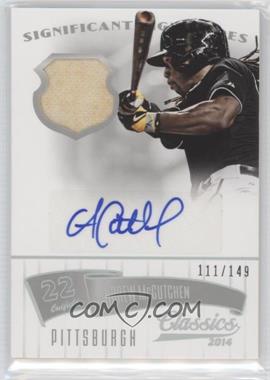
2014 Panini Classics - Significant Signatures Materials - Silver Jerseys #3 - Andrew McCutchen /149 - Courtesy of COMC.com
2014 Panini Classics - Significant Signatures Materials - Silver Jerseys #3 - Andrew McCutchen /149
In the following years, I occasionally watched the World Series, but nothing else.  I saw Jim Leyland, Bobby Bonilla, Darren Daulton, and others win with Marlins in 1997.  I didn't care about all the years the Yankees won.  I remember Randy Johnson and Curt Schilling leading the Diamondbacks to victory in 2001, Troy Glaus and the Angels in 2002, the Marlins again in 2003, the Red Sox breaking their curse in 2004, and the Phillies getting their second championship in 125 years of existence in 2008.  I don't think I watched any other years.

Then my son was born in the summer of 2015.  My wife had maternity leave in the summer, and I had paternity leave in the fall.  My son and I spent a lot of hours alone together that fall.  I bought the MLB online package (we were out of market for the Pirates back then) and started watching the Pirates again, after over 20 years of absence.  It was easy to be a fan again, what with time to watch the games again, and with McCutchen leading the Bucs to a 98-64 record and what was their third recent playoff experience.

The 2016 and 2017 seasons weren't as successful and were harder to watch, but it was still a lot of fun.  McCutchen was the key to the team both these years, and seeing him rebound in 2017 was awesome.  It has been frustrating as the management has decided not to make moves that would lead to better outcomes, and now that they're disassembling the team that drew me back into baseball.

I've said before that I only own 17 cards from post-1994.  One of those is a George Foster that I got in a trade with Greg from The Collective Mind.  The other 16 are recent Donruss cards I bought at the dollar store (four packs of four cards) this past year.  I did just recently buy three more modern cards, though; they're in my COMC account, so I don't actually have them yet, and I wasn't going to post about them until I received them.  But I decided to put up the McCutchen that I bought, using a COMC picture.  Until now, the only autographed cards that I've had were signed at card shows that Dad and I attended together back in the day.  I don't expect to get many modern cards, and this includes not looking for many modern autographed cards.  But I wanted one of McCutchen, who more than anyone else in MLB is why I'm watching the Pirates again.  I bought one of the above 2014 Panini Classics Significant Signatures Materials cards a few weeks ago; the one pictured isn't mine (which is numbered 10/149) but is another for sale at COMC.  I was hoping to be watching McCutchen as a Pirate for a long time, but that isn't how baseball works these days.  Instead, this card will commemorate my return to baseball fandom.

Monday, January 1, 2018

Happy New Year, Blog Note, and Favorite 2017 Card

Happy New Year!  Let's hope that some good things happen in 2018.  If we stick to just baseball, that means, for me, hoping that the Pirates keep McCutchen, stay healthy, and continue to develop their pitching.

Now, a note about the blog.  I said before, in my 100th post, that I don't think I can maintain my pace of daily posting without running out of material.  When I started this blog in August, I set a goal for myself of daily posts for 3 months.  When 3 months came and went, I didn't want to slow down, and decided to keep posting daily for a bit longer.  I made it through the end of 2017, but now I think it's time to shift down a bit.  Starting tomorrow, I'll be posting 4 times a week, on Tuesdays, Thursdays, Saturdays, and Sundays.

As long as I'm talking about the blog itself, let me say that I so appreciate everyone who has taken the time to read.   I started this blog to record stories about the baseball cards that I loved as a kid, and since then I've also discovered the joy of using internet commerce to round out my collection.  I love sharing both my old stories and cards and my new additions, and I've enjoyed discovering all the other card blogs that are out there (and have been out there for years).  It's very gratifying to  participate in the conversation, to be a part of a community of cardbloggers, and to know that there are people out there listening.

Now, since this is indeed a card blog, I think I should have a card in each post.  So I thought I would add my favorite card of 2017, as other cardbloggers have been doing.  That's a bit hard for me, though, since I don't focus on modern cards.  I have a very small number of cards (only 17, I think) that are post-1994.
2017 Donruss Paul Goldschmidt.
Of those 17 are 12 2017 Donruss cards that I bought at a dollar store recently.  This Goldschmidt is easily my favorite, for a personal reason -- from the back of this card, I learned that Goldy was born in Delaware (like me).

So, that's it for 2017.  Again, Happy New Year, and thanks for reading.  The new posting schedule starts tomorrow.