Showing posts with label beat-up cards. Show all posts

Monday, March 30, 2020

What I'm doing during our isolation: Rewatching the 1987 World Series

Of course there's no new baseball these days.  So I'm recreating what was for me a formative experience, watching the 1987 World Series.

In the fall of 1987, I was eleven years old, just about to turn twelve, and I had started seventh grade.  My parents had separated less than a year ago and my older brother had started high school.  Within that past year I think I had been shedding childhood interests such as Transformers and G.I. Joe, and I turned to baseball.  I had always had some interest in baseball but the 1987 season is when I started following daily, and the 1987 World Series is the first that I made a point of watching.  Dad wasn't around that year (my parents got back together later), and who knows what my older brother was off doing.  But Mom and I watched that 1987 World Series together, and it was a great series.  Fortunately the whole thing is on YouTube, and I'm currently partway through Game 4.

One thing that 1987 series did for us was make us aware of Kirby Puckett.
Two 1985 Topps Kirby Puckett rookie cards.
I of course instantly searched through my cards back then, to see if I had any Kirby Puckett rookie cards.  Lo and behold, I did.  I only had a handful of pre-1987 cards, but there were some good ones in there.  Over the subsequent years I managed to add another copy of it.  You can clearly see the flaws in both of them in this scan, but that's no matter -- these Pucketts mean a lot to me.

I went digging through my main binder to see who else from the 1987 Twins or Cardinals I had.  I only turned up a handful, and maybe my secondary binder has more.  But another then-valuable rookie card I had was a 1986 Donruss Vince Coleman.
1986 Donruss Vince Coleman.
Back then the view was that Coleman was the NL's Rickey Henderson.  Coleman had some great seasons, but Henderson turned out to have a much more impressive career.
1987 Fleer Update (glossy?) Joe Magrane and 1987 Fleer Jack Clark.
The other two Cardinals from that team in my main binder are Joe Magrane and Jack Clark.  Magrane was in the update set, being a rookie pitcher that year.  It doesn't show in the scan, but the card is actually extremely shiny/glossy, so I suppose it must have come from the Fleer tin set.  I never bought a Fleer tin set, so I must have just picked up the one card somewhere.  Watching the 1987 series, the announcers frequently lament that Jack Clark wasn't playing, and that Terry Pendleton wasn't at full strength.  Of course there's no telling for sure, but one suspects the close series may have turned out differently had those guys been healthy.

It goes without saying that I'm having trouble finding the time to blog.  My last post before this was almost four months ago!  Being home all day isn't helping, as I have to take care of our almost-five-year-old son while my wife works from home (I work from home too but with more flexible hours).  Let me close just by wishing that you all stay well!

Tuesday, January 15, 2019

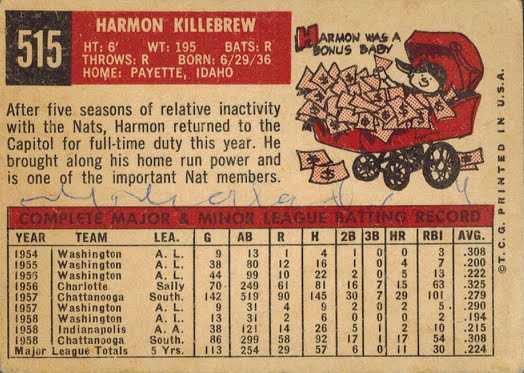
Harmon Killebrew in my collection

I've meant for a long time to do a post of the Harmon Killebrew cards in my collection.  I've had two good cards of him, and a handful of others of him, in my collection for a long time, and I've picked up some more good ones recently.
1959 Topps Harmon Killebrew.
1959 Topps card back.
This is one of the two good ones, his 1959 Topps card.  I was most familiar with the 1959 design in the late 80s and early 90s from the Baseball Cards magazine repli-cards of then-current players.  But I did manage to pick up exactly one 1959 Topps card back then; I wish I knew where I got it or how much it cost.  As you can see on the card back, the card has been written on.  Getting damaged cards was a strategy I employed back then to get vintage Hall-of-Famers.
1969 Topps Killebrew.
1982 K-Mart MVPs.
The other good card of Killebrew from my original collection is this 1969 Topps.  You can see the damage very clearly -- it's got what I think is a wax stain across the front, and it's got multiple creases including a big one all the way down the front.  As the 1982 K-Mart 20th Anniversary card shows, Killebrew had a good year, being named the 1969 AL MVP.  This K-Mart card was also part of my original collection from the 80s and 90s.
1972 Topps Killebrew.
1972 Topps Killebrew In Action.
I've picked up a couple more vintage Killebrew cards as part of building a 1972 Topps set.  He has a regular card and an In Action.  He was getting towards the end of his career, but still appeared on Topps cards through the 1975 set.
1972 Topps AL RBI Leaders.
Killebrew had one more appearance in the 1972 set (I'm not counting a Twins team picture) on this 1971 AL RBI leaders card.  He led the AL with 119, which was third in the majors behind Joe Torre of the Cardinals with 137 and Willie Stargell with 125.  Next in the majors were Hank Aaron with 118, Bobby Bonds with 102, and then the next AL player was Frank Robinson with 99, tied with Willie Montanez of the Phillies.  Next in the NL were Lee May with 98 and Rusty Staub with 97.  Placing third in the AL was Reggie Smith of the Red Sox with 96.  So these three, Killebrew, Robinson, and Smith, were the only three AL players in the MLB top ten in RBI in 1971.
1962 Post Killebrew.
1968 Topps Embossed Killebrew.
These two, the 1962 Post and the 1968 Topps Embossed insert, are also recent acquisitions since I've resumed collecting.  I posted these both already when I got them.  In both cases, I bought a small number of cards to represent these sets in my collection (and in my main binder).  I posted all of the 1962 Post cards, but my other couple of embossed cards I never posted.  I'll show them soon.
1985 Circle K Home Run Kings.
1987 K-Mart Stars of the Decades.
One of my favorite acquisitions since I restarted collecting is the 1985 Circle K Home Run Kings set.  Here's Killebrew's card from that.  The guys in that set are, to me, the real deal.  I think the worst part of baseball's steroid era is the use of those drugs to destroy baseball's great records, baseball's history.  The home run records mean nothing today.  But back then, when local hero Mike Schmidt finished 7th all time, I loved learning about the guys in front of him -- Reggie Jackson, Harmon Killebrew, Frank Robinson, Willie Mays, Babe Ruth, and Hank Aaron.

Then we have another K-Mart card, from the 1987 set featuring stars of the decades.  Killebrew would have been one of the stars of the 60s.  We'll see if K-Mart is around much longer; it's not looking good.  My wife and I have moved a lot, but in different places over the years, when we've lived near a K-Mart we've shopped there, and my family shopped there sometimes when I was a kid in the 80s.  All of that is commemorated in my collection with my three K-Mart sets.
1988 Pacific Legends Killebrew.
2018 Donruss Killebrew, in the 1984 style.
Finally we have these two, a Pacific Legends that I pulled from a wax pack back in the day, and a current Donruss card in the 1984 style, that I pulled from a dollar store pack last year.

Thanks for reading!

Thursday, December 27, 2018

Eight from 1956 Topps

I showed a few 1956 Topps I picked up a while ago.  Then I went and bought some more.  I'm definitely not collecting the set, so I'm not entirely sure why I keep buying them.  But it is a really beautiful set, so they're hard to resist, I guess.
Gus Bell, Cincinnati Redlegs.
Elmer Valo, Kansas City A's.
Of these eight cards, which arrived in my COMC Black Friday box, I mostly bought them to feature teams that no longer exist, at least in their configurations back then.  So we start off with the Cincinnati Redlegs, who called themselved that briefly, rather than Reds, at the height of the Red Scare; I showed another Redlegs card just recently.  I'm also glad to have a nice card of Buddy's dad Gus.  Then we have Elmer Valo of the Kansas City A's.  When I was growing up I knew the A's were in Oakland but had been in Philadelphia (Connie Mack still loomed large enough in Philadelphia baseball history for me to know about those old A's teams as a little kid in the 80s), but it came as something of a shock to me to learn that they made a stopover in Kansas City for a few years.  So now I have a couple of Kansas City A's cards, which in a way are a part of Philadelphia baseball history, in my collection.

Elmer Valo was born in what is now Slovakia in 1921.  He had a long career from 1940 through 1961, with the Philadelphia Athletics for many years but then with the Kansas City A's, Phillies, Brooklyn Dodgers, Los Angeles Dodgers, Indians, Yankees, Senators, and Twins.  So he was with three different teams that moved cities during his tenure with them.  Valo was a career .282 hitter with 1420 total hits and 601 RBI.  Valo is on the Philadelphia Baseball Wall of Fame.
Curt Simmons.
Vic Power, Kansas City A's.
I showed another card, the 1955 Bowman, of Curt Simmons recently.  He was a solid pitcher for many years who is of interest to me as part of the 1950 Whiz Kids; he had other career highlights including winning the World Series with the 1964 Cardinals.  Vic Power is another of the Kansas City A's, who also started with them in Philadelphia and made the move.  Power was a six-time All-Star and seven-time Gold Glove winner in his career from 1954 through 1965.  He is considered to be one of the greatest Puerto Rican baseball players.  Comparing the two A's cards, you see that Topps spelled out "Athletics" on the Valo card but abbreviated "A's" on the Power card.
Ruben Gomez, New York Giants.
Hank Thompson, New York Giants.
Then I picked up two New York Giants, Ruben Gomez and Hank Thompson.  Their hats look different colors, with the Gomez hat looking black and the Thompson hat looking blue.  I've read that the Mets took the blue hat from the Dodgers and the orange "NY" logo from the Giants, so I wouldn't have thought the New York Giants had a blue hat.  Gomez and Thompson were both part of the 1954 champion Giants team.  For Thompson, 1956 was his last year in the majors.  Thompson was the first black player to play for the St. Louis Browns, playing with them on July 17, 1947.  On July 20, he and Willard Brown both played with the Browns, making the first MLB game to have more than one black player in a lineup.  Later that season in a game against Cleveland, he and Larry Doby became the first black players to play in the same game on opposing teams on the field at the same time.

Ruben Gomez pitched in the majors from 1953 through 1967, but with some gaps.  He wasn't in the majors in 1961 or 1963, and played in Mexico from 1964 through 1966.  In the 1954 championship season, he went 17-9 with a 2.88 ERA.  Other than the New York and San Francisco Giants, he played with the Phillies, Indians, and Twins in his MLB career.  He also had a lot of success continuing to play in Puerto Rico afterwards.
Gus Triandos, Baltimore Orioles.
Sherm Lollar.
Closing this post out, we have Gus Triandos of the Baltimore Orioles and Sherm Lollar of the White Sox.  These two, like the Curt Simmons above, don't fit the "teams that no longer are" paradigm.  But the Orioles are the flipside of that, with the Orioles only having recently come into existence in 1956, when the Browns moved from St. Louis to Baltimore for the 1954 season.  And the White Sox have nothing to do with the moving of teams, of course, but I liked the old White Sox hat on Lollar in his picture.  Lollar was a 9-time All-Star, 3-time Gold Glove winner, and was on the 1947 champion Yankees team.  Triandos was a four-time All-Star.

Thanks for reading!

Tuesday, December 18, 2018

Missing years, no more

Before I left for college in 1993, I made sure that my main binder, with all my best cards, was organized in a way I was happy with, for it to stay that way forever, basically.  It lasted about 23 years, until I started to update it in 2016.  The binder starts with my favorite Topps cards chronologically, and these are 9-card pages so it only starts with standard-sized cards, i.e. post-1956.  Back then, the oldest card I had there was my 1959 Topps Harmon Killebrew, and after that it jumped to my 1962 Topps Robin Roberts.  Then I had a 1963 Roberts as well, and then a 1965 Juan Marichal.  Then I had all the years after that represented.  In updating, I decided I wanted all the years represented.  I showed a 1958 John Roseboro, and a 1960 Frank Robinson, but that left 1957, 1961, and 1964 to fill in.  So that's what we have today.
1957 Topps Robin Roberts.
Robin Roberts and Richie Ashburn cards, to me, represent my dad.  Dad was an orphan in the 50s and lived in a locally well-known orphange/school in Philadelphia.  They would take him to Phillies games at Connie Mack stadium every now and then, and he was definitely a Phillies fan.  So even though I have a number of Roberts cards already at the front of the binder, I went for one more.  This 1957 fits in condition-wise with a few of the others, as you may be able to see the multiple creases in the scan.
1961 Topps Bob Gibson.
The greatest pitchers of the 1960s are said to be Bob Gibson, Juan Marichal, and Sandy Koufax.  To represent 1961 in the binder, I went with another Gibson card.  (Koufax cards are expensive!)  He's young here, just a couple of years off his 1959 Topps rookie card.  I showed all my Bob Gibson cards once before, and all my Juan Marichal.  My only good Koufax card is the 1967 NL Pitching Leaders card that I showed once.  This Gibson is now my oldest card of him, beating my previous best, the 1969, by several years.
1964 Topps Duke Snider.
I saw a copy of this Duke Snider card on another blog (sorry I don't remember who), and I had to have one for myself.  It works perfectly that Duke can represent 1964 in my binder, as well as representing those very early New York Mets teams.  It's my second good card of Snider, after the 1955 Red Man tobacco card I showed previously.

Thanks for reading!

Tuesday, December 11, 2018

Harold Baines to the Hall

I'm happy to see that Harold Baines has made the Hall of Fame.  He's always been a favorite of mine.  My 1981 Topps Harold Baines rookie cards were one of the first subjects of a post at this blog.

After I mostly checked out from baseball after the 1994 strike, I've only recently found out how the careers of some of the players I used to watch ended up.  While it would have been unbelievable in 1987 that Don Mattingly wouldn't make the Hall, if you look at his career numbers, it makes sense that he's not in.
A very beat-up 1982 Topps Harold Baines.
What about Baines?  It's just my opinion, but when I look at his career numbers, they look like Hall of Fame numbers to me.  Let me start with WAR: I don't believe that there's a single number that accurately sums up every player's career.  That's how people talk about WAR.  I think most people don't truly understand what WAR is.  I'm glad the Veterans Committees take a broader view.
1990 Fleer All-Star Harold Baines.
1991 Topps Harold Baines.
Let me give some stats: Baines is currently 34th on the all-time RBI list with 1628.  Only 36 players have ever made 1600 RBI.  I think that's pretty impressive.  He also has 384 career home runs and 2866 hits.

How many players have ever made 1600+ RBI, 350+ home runs, and 2500+ hits?  By my count, the answer is 27.  Of these, 19 (including Baines) have made the Hall, 3 are active players, and there are 5 others.  Here are the groupings:

Hall of Fame: Hank Aaron, Babe Ruth, Lou Gehrig, Stan Musial, Jimmie Foxx, Eddie Murray, Willie Mays, Mel Ott, Carl Yastrzemski, Ted Williams, Ken Griffey, Jr., Dave Winfield, Frank Robinson, Reggie Jackson, Cal Ripken, Jr., Tony Perez, Ernie Banks, Harold Baines, and Chipper Jones.

Active players: Albert Pujols, Adrian Beltre, Miguel Cabrera.

Others: Alex Rodriguez (not yet eligible), Barry Bonds (tainted by steroids), Rafael Palmeiro (tainted by steroids), Manny Ramirez (still on the ballot), Gary Sheffield (tainted by steroids).
Keebler Rangers Harold Baines.
Stuart Super Stars Harold Baines.
I'm not saying that Baines was a slam dunk for the Hall.  But he has a credible case.  His career numbers are very similar to some other enshrined players, such as Tony Perez and Robin Yount, for example.  In addition to Perez, Baseball Reference also puts him as being most similar to Al Kaline, Dave Parker, Billy Williams, and Andre Dawson.  Other than Parker, they're all in the Hall, and I hope that Parker will be one day, too.  After that, Baseball Reference also puts him as similar to Rusty Staub and Dwight Evans, among others, who of course aren't in the Hall.  I guess the online consensus is that he should fall on the Staub and Evans side of Cooperstown, but for myself, I am pleased that the Veterans Committee decided otherwise.

Side note: the last two cards here were cards I bought at COMC sometime in the past year, while the first three have been in my collection for decades.  Does anyone know what Stuart, of the Stuart Super Stars card, was? 

I understand the arguments against; your mileage may vary.  Thanks for reading!

Friday, November 30, 2018

From My Collection: Some 1988 Score Box-Bottom Cut-Outs

I used to buy a number of wax boxes back in the height of the junk wax era, and now I have some of the box-bottom cards.  Back then we didn't actually call Score boxes "wax boxes."  They had different packaging, so they were called mylar boxes.  But that's just a technicality.  I bought many packs of 1988 Score, but only one complete box, so I have 4 of the box-bottom cards.
1988 Score Box-Bottom trivia card.
Trivia card back.
I really enjoyed the Score magic motion trivia card inserts.  I guess in contrast to Topps' gum, Fleer's stickers, and Donruss' puzzle pieces, Score had to think of something to put into packs with the cards.  (Did they really, though?  Couldn't they just have had the cards?)  So they put in trivia cards, and not just any trivia cards, but Sportflics-style "magic motion" cards.  Well, on the box bottom, you don't get magic motion, you just get hte trivia.  I, for one, did not remember what happened at Comiskey park on July 6, 1983.  But apparently a grand slam broke a jinx.
Dave Winfield.
Dave Winfield card back.
The other three cards are more traditional, and Score used them for a little All-Star set which isn't all that different from the Topps rack pack All-Star cards.  I'm not sure why my Dave Winfield has such a big crease.  While the box bottom might have some damage when it's intact, it's not likely to actually be creased with all of the packs inside.  And by 1988, I was mainly taking better care of my cards.  But in any case, this is quite a beat-up card, which I'm still quite happy to have.
Gary Carter.
Ozzie Smith.
Finally, we have two more perrenial All-Stars, Gary Carter and Ozzie Smith.  I wasn't a fan of Carter per se, since he was with the Mets.  (If Dad and I went to Phillies-Mets games at the Vet, Mets fans would come down and start fights.  We stopped going to Mets games.)  It was always fun to watch Ozzie Smith play, and especially to watch him take the field.

Thanks for reading!

Monday, May 28, 2018

Bob Gibson in My Collection

It's been almost three weeks since I've posted.  I did say a while ago that, being slammed at work until mid-July, I'd have trouble posting until then.  It's more true than I thought it would be, and hence the long absence.  Anyway, with the long Memorial Day weekend, I do have a bit of time, and thought I would finish up this long-planned post on Bob Gibson.
1969 Topps Bob Gibson.
1972 Topps Bob Gibson.
This beat-up 1969 Bob Gibson card has long had a place of pride in my binder.  I feel certain that I bought this at Stale Gum in Newark, DE in the 80s.  Stale Gum was a card shop on Main Street in the 80s, and it closed around the time that about a dozen other shops opened.  So, going to Stale Gum was a feature of my early collecting days, and I remember getting some of my first-ever pre-1978 cards there, like my 1974 Carlton Fisk and Billy Williams cards, and this Bob Gibson.   The 1972 Gibson is a recent addition to my collection, as part of my project to assemble a 1972 Topps set.  (Current status on the 1972 set: just over 300 cards, for just over 38% of the total.)
1973 Topps Bob Gibson.
1974 Topps Bob Gibson.
The 1969 card is special to me for more than just my memories of going to Stale Gum, but also for baseball reasons: it reflects his monster 1968 year with his 1.12 ERA.  They say that the three best pitchers of the 60s are Bob Gibson, Sandy Koufax, and Juan Marichal.  A natural strategy for me to get Gibson into my collection, when I was a kid in the late 80s/early 90s, was to go for cards in bad condition like the 1969, and for cards at the end of his career.  Being a great pitcher of the 60s, these  1973 and 1974 cards are some of his last, and I've always been happy to have them since I like both designs so much.
1975 Topps Bob Gibson.
Pacific Legends Bob Gibson.
I also got his 1975 card back in the day.  The 1969, 1973, 1974, and 1975 made my Bob Gibson collection deeper than what I had for most other 1960s Hall-of-Famers.  I also pulled this Pacific Legends card of him from a wax pack.  I guess I have a couple of other nostalgia cards of him, like from the K-Mart sets, but as far as things like that go, I think I like the Pacific cards best.

Thanks for reading!  Like I said, through mid-July, posting will be spotty, but I'll do what I can here and there.

Sunday, April 15, 2018

As I Enter into the Trading Card Database

I've been working on entering my cards into the Trading Card Database; in one sense I'm about halfway done, since it shows I've entered about 15,000 cards, and I believe that I own about 30,000 cards.  But the majority of what I've done is low-hanging fruit, entering the complete sets that I own, such as the 1989 and 1990 Bowman factory sets, the 1990 Fleer factory set, 1988, 1990, and 1991 Donruss factory sets, a 1984 Topps hand-collated set, and a bunch more.  The longer work of going through all my boxes of cards has only just begun.  But, I have entered a few of these boxes, and I've unearthed a few cards of players that I've featured before, that I wanted to show.

(Note: this post originally published accidentally prematurely, without any text.  Sorry!)
1984 Fleer Oscar Gamble.
As you can detect from the cards I'm featuring here, I have recently entered a box of my 1980s Fleer cards into the database.  When Oscar Gamble died, I made two posts about him.  First, I showed the cards I could dig out of my collection on short notice, especially his 1979 Topps card from my complete set, but also his 1985 Fleer Update, and his Pacific Senior League card.  Then I purchased his iconic 1976 Topps Traded card, by purchasing a 1976 Topps Traded Yankees team set.  This 1984 Fleer was also in my collection but I wasn't aware; I see how having an electronic record of your cards can be helpful for putting together posts like this.  I've always liked the clean design of the 1984 Fleer set, and this is a nice shot of Gamble (and his smile) towards the end of his career.
1985 Fleer Dickie Thon.
I posted about Dickie Thon once before.  He had a promising early career, before being seriously beaned by Mike Torrez in 1984.  It was years until he played everyday again after that, but he did get a chance to be the starting shortstop for the Phillies for a few years circa 1990.  This 1985 Fleer card reflects the season in which he was beaned; the picturemust be from before the incident.
1982 Fleer Lance Parrish.
1986 Fleer Lance Parrish.
And then we have Lance Parrish.  I've featured him many, many times in the months that I've been writing this blog, although it never seems to be on purpose.  Parrish was, of course, an All-Star catcher with the Tigers before joining the Phillies.  There were very high expectations in Philly and he didn't exactly perform at the expected level, so he was routinely booed by the Philly sports fans.  Lance Parrish didn't like that, for some reason.  He moved back to the AL after two seasons with the Phillies and did better, making the All-Star team again and winning another Silver Slugger with the Angels.  These cards show him in his happier times with Detroit.  It's funny to me how you can see him grow up in the two cards, four years apart -- he looks much more younger in the 1982 card.

My posting for the past week or two has been almost nonexistent, as I've struggled to get over some small illness.  Having finally gone to the doctor, though, I am now feeling much better, and I think I can get the blog back on track.  Thanks for reading!

Saturday, March 31, 2018

Starting Lineup Talking Baseball: AL All-Stars

Last Saturday, I showed the NL All-Stars from my 1988 Starting Lineup Talking Baseball game; the game was a gift I got for my 13th birthday.  This week we have their opponents in the game, the AL All-Stars.
Dave Winfield.
Robin Yount.
Starting off, two members of the 3000-hit club, Dave Winfield and Robin Yount; this will be a theme throughout this set.  I always liked Dave Winfield a lot as a player.  I remember him with the Yankees, Angels, and Blue Jays, but we never saw AL games very often.  With the Yankees, I remember him feuding with George Steinbrenner; that's a mark in Winfield's favor in my book.  With the Blue Jays, I remember him winning the World Series with them in 1992.  I don't have much knowledge of Yount beyond his cards, since he was in the AL and since he didn't make the postseason while I was watching baseball.
Bret Saberhagen.
Don Mattingly.
I've been entering my collection into Trading Card Database, and so far, Don Mattingly is one of the players I have the most cards of.  I think that's because most of the little boxed sets at the time included him, and most base sets at that time probably found multiple ways to include him.  It's too bad his production dropped off after a few peak years.  Bret Saberhagen was a two-time Cy Young winner in the AL with the Royals, but when switched to the NL with the Mets, he mostly wasn't as effective.  He did have the occasional good year towards the end of his career, though, such as going 14-4 with the Mets in 1994 and going 15-8 with the Red Sox in 1998.
Willie Randolph.
Lou Whitaker.
I posted before that I picked up Willie Randolph's 1976 Topps Traded card; that was a nice by-product of my search for the iconic Oscar Gamble card.  I've said before, too, that it's nice that the 1984 Tigers finally have some Hall-of-Famers, but it would be even better if Lou Whitaker got his due as well.
George Brett.
Kirby Puckett.
Here we have who I consider to be "the other third baseman," George Brett.  When the Phillies retired Mike Schmidt's number, Dad and I were at the game.  I remember that they played a video message from Brett on the big screen.  Brett is the third member of the 3000-hit club pictured here so far.  I became a fan of Kirby Puckett during the 1987 World Series, and was glad to see them win again in 1991.  I'm glad to have a couple of his rookie cards in my main binder.
Dave Righetti.
George Bell.
I always remember Dave Righetti for his 1987 Topps record breaker card.  That's not a record which has held up.  I was glad to see him on TV more recently, when the Pirates played the Giants.  Apparently he's in the Giants front office now, and not on the field anymore.  I'm sorry to say that I barely remember George Bell, other than that he was one of many talented players to go through Toronto in their build-up to their back-to-back World Series wins.  It's too bad that he was no longer with Toronto by that point.
Eddie Murray.
Rickey Henderson.
Here are two of my all-time favorites, Eddie Murray and Rickey Henderson.  I really admire Murray's consistency; it's as if he decided in the beginning to hit 500 home runs in his career by hitting 25 per year for 20 years.  Rickey Henderson was slammed in the media for saying that he was the greatest, but I think that was ridiculous -- he absolutely was the greatest, so I think it was fair for him to say so.  Murray and Henderson are the fourth and fifth 3000-hit members represented here.
Cal Ripken, Jr.
Dan Quisenberry.
Cal Ripken, the Iron Man, is a local guy around here.  Maybe I'll make it to Ripken Stadium in Aberdeen sometime with my family, to catch a minor league game.  Cal is the sixth 3000-hit club member here.  Dan Quisenberry is one of many baseball players (including several Royals and several Phillies) to have died of brain cancer.  Quisenberry led the AL in saves five times, on his way to a career total of 244.
Wade Boggs.
Alan Trammell.
Wade Boggs is our seventh and final member of the 3000-hit club in this set of 20 AL All-Stars.  The corresponding NL set didn't have any, although they could have had Tony Gwynn.  When the game came out in 1988, the 1984 Tigers championship was a recent memory, and including the MVP of that World Series makes sense, especially since he had an even better year in 1987 than he did in 1984, batting .343 with 105 RBI.
Jack Morris.
Terry Kennedy.
The third member of that 1984 Tigers team in this set, and second recent Hall-of-Famer, is Jack Morris.  The upside of Morris' case for the Hall is being the winningest pitcher of the 80s and being a three-time World Series champ.  The case against has to do with his high ERA and sabermetrics.  Popular sentiment was on his side, I suppose.  Then we have Terry Kennedy, who made significant contributions to a few different teams over the years; he was an All-Star with the Padres and the Orioles, and was on the losing side of that 1984 World Series with the Padres.
Roger Clemens.
Carlton Fisk.
Through 1988, Roger Clemens had led the AL in wins twice, ERA once, shutouts twice, and strikeouts once, winning two Cy Young awards and the AL MVP, and he probably hadn't started using steroids yet.  And finally, we have Carlton Fisk, who was quite popular at the end of his career, as people appreciated his longevity.

That wraps up this go-round.  I have more of these Starting Lineup Talking Baseball cards I'll feature for the next three Saturdays.  Next week: the Pirates team set.