Showing posts with label Delaware. Show all posts

Sunday, December 6, 2020

Two from 1960 Fleer

A while ago I picked up some Chuck Klein and Grover Cleveland Alexander cards for my main binder, since they're two of the four Phillies whose "numbers" were retired back in the days that Dad and I went to all those games at the Vet in the late 80s.  I say "numbers" because Klein and Alexander were from before the days of players wearing numbers, or at least from before the days of players consistently wearing the same number.  So they just had their names/initials hung up.  The other two, of course, were Richie Ashburn and Robin Roberts.  Others would join those four, and Dad and I got to go to the games where Steve Carlton and Mike Schmidt had their numbers retired -- the souvenir programs from those games will eventually make it to their own posts.

Anyway, for the Klein and Alexander, I also used them as an excuse to get my first 1960 and 1961 Fleer cards.  I considered and decided against collecting those Fleer sets, but did want to get a couple more.  So here they are.

1960 Fleer Honus Wagner.
Honus Wagner card back.
I don't have a lot of cards of Honus Wagner, despite being a huge Pirates fan.  This is probably because there aren't that many cards of Wagner, at least that are (a) affordable, and (b) from before 1994 when the bulk of my collecting stopped.  Other than this new one, I appear to have 3 Wagner cards: a Baseball Immortals, a Red Superstar, and a Fritsch Museum card.  (The Fritsch Museum set will also be a post of its own at some point.)  The Fritsch Museum card is in my binder so it's not like Wagner is unrepresented there.  But I think this 1960 Fleer becomes by far my best card of him.
1960 Fleer "Jimmy" Foxx.
Foxx card back.

Then we have Jimmie Foxx, spelled here as Jimmy Foxx.  I have two different pictures of Foxx in my mind, one of which is that he was a huge star, having been a 9-time All-Star and 3-time AL MVP.  On the other hand, I don't know how true it is, but I heard at least once that people didn't realize at the time how significant his 500+ home runs were because Babe Ruth had 700+.  Other points making me a fan of Foxx are that he's a local guy in more than one way -- he was from the Eastern Shore of Maryland, with his hometown being only about 40 miles away from my hometown of Newark, Delaware.  And as a player he was a huge figure for Connie Mack's Philadelphia Atheletics.  When I was a kid I remember the Phillies remembering the Athletics tradition in Philadelphia, callling their Wall of Fame the Philadelphia Baseball Wall of Fame and inducting the old Athletics alongside Phillies.  Of course Foxx was the second Athletic so honored, after Mack.  This isn't by best card of Foxx, but since my 1940 Play Ball is PSA-graded it can't go in the binder.  Instead this 1960 Fleer is a great representation of him for the binder.

I'm on a roll with two posts in two days.  Thanks for reading!

Monday, August 31, 2020

Movie Post: Big Leaguer

 It's been over four months since my last post.  I find it hard to pay much attention to baseball cards these days, but have a number of posts I've been planning to write over these past months.  I woke up a bit early this morning and thought I might finally get one post out.

One morning in quarantine (months ago now) I remembered a movie I once saw, years ago now, on one of the cable channels, American Movie Classics or Turner Classic Movies.  It was about spring training in Florida, and featured the New York Giants and the Brooklyn Dodgers.  The main thing I remembered is that the Giants let go a pitching prospect but weren't sure if it was the right thing to do, then he showed up against them in a spring training game against the Dodgers.  I thought it was probably from the 50s, and a little searching of baseball movies from the 50s turned up the title: Big Leaguer, starring Edward G. Robinson.

1940 Play Ball Hans Lobert.
1940 Play Ball Hans Lobert card back.

 The movie isn't a true story, but Robinson plays a real guy, Hans Lobert.  In the movie Lobert's playing days are over and he runs the Giants' spring camp in Florida.  Spring camp then, at least in the movie, isn't like it is today. According to the movie it was like an open tryout -- young guys from all over could come stay at camp and show the Giants what they have, hoping for a minor league contract.  And Lobert ran the camp, hoping to find a star so the Giants would keep him on running the camp.

I bought this 1940 Play Ball card of Lobert.  I bought another card related to the movie too, but can't show it because COMC says that my shipment won't arrive until October.  That's an Edward G. Robinson card.  I don't usually go for non-sports stuff these days (although I do have a bunch of mid-90s Marvel and DC superhero cards).  But I thought these would make a nice pair together, Lobert and the guy who played him in the movies.  The Robinson that I bought is a 1939 Milky Way Famous Film Stars card.  It's always nice to have another food-issued card, I think, and nice to add a card from the 30s.  Come to think of it, the Robinson might now be my oldest card!  I don't think I have any others from the 30s, and I don't think I have anything older.  I'll post it when I get it, but like I said, COMC said the shipment I requested in July will come in October.

It's just occurred to me, as I write this post, that there's another card from the movie that I should have bought, so I just ordered it right now.  That's a card of Carl Hubbell.  I guess they wanted to add some baseball star power to the film, so they had Hubbell appear to watch the game at the end between the Giants kids from camp and the Dodgers' minor-leaguers.  So I just ordered a 1940 Play Ball of Hubbell from eBay to go with this one.

Overall I would say that the plot of the movie isn't that strong, but it's interesting to see even a fictional window on the past of baseball.  The movie has a shot of the Polo Grounds.  I've said many times before I have a certain fascination with the bygone stadiums, and of that moment in time before baseball moved west.  If you haven't seen the movie, it's a quick, easy watch; I think I bought it on iTunes for a few bucks.  

I might say a few words about Lobert, since he's the card I'm using to represent the movie.  As a personal plus, he was born in Wilmington, Delaware, like me, and according to Wikipedia, he was an alum of Carnegie Mellon University, like me (it wouldn't have been called Carnegie Mellon back then, but still).  He was an infielder with the Pirates, Cubs, Reds, Phillies, and Giants between 1903 and 1917, and briefly managed the Phillies a couple of times.  He continued to work in baseball for many years.

This is my second of the 1940 Play Ball series, after the Jimmie Foxx card I got myself for Christmas a couple of years ago.  I have another 1940 Play Ball that I just got that will be the subject of another post.

https://blogger.googleusercontent.com/img/b/R29vZ2xl/AVvXsEi0RgF-l2oco85j8Pa47F59OkNcEo4NPcJfVXnzsbDc5jfyo6rXAv70y1dn7t7FX2ELNMpveCYLdC26eo-1WWEGNRi6CFm-D7lAMD3wCjpzgH_lj7b2gwXX-nEUiGzp87JUyYWqfcq6Rq8e/s1600/CCI07122017.jpg
1940 Play Ball Jimmie Foxx.

I'll end the post here, I suppose. I hope you're all doing well.

Thursday, August 8, 2019

Three vintage Phils for my second blogiversary

I just caught my blogiversary in time to make a post for it.  Today is two years blogging, although the blog posts come infrequently these days.  In a sense I write for a living; I'm a math professor, and I mainly write research papers.  There's a lot of other writing, too, though, which in various forms involves either advocating for my own research (like in grant proposals) or evaluating other people's research (like in reports on other people's papers, theses, grant proposals, and tenure cases).  Much of this involves responsibility to other people -- if I don't work on writing a paper, I might be letting a coauthor down.  Which is all to say that writing on a blog sometimes has to take a back seat.  But I try to get back into it after I've been away for a while, and I see that it's been more than a month since my last blog post.  So as usual when I've been away, I'll say now that I want to get back to it, and I'll start now with three vintage Phillies.
1961 Topps Dallas Green
Dallas Green was a hero to us kids in the greater Philly area in the early 80s, although perhaps not in the same ways as Schmidt and Carlton, or even Bowa, Trillo, Bowa, Boone, Maddox, or McGraw.  But Dallas Green was the manager who delivered the first World Series for the Phillies.  He didn't hang around much after that, and was soon off to the front office of the Cubs.  But he was in Philadelphia long enough to deliver.  His 1980 Topps Burger King card has always had a place in my binder.  I decided to get a card of him as a player; he didn't only play with the Phillies, but it looks like all his cards have him with the Phils.  He was only briefly with the Senators and the Mets.  Green also is another special collection of mine, which is of Delawareans who made it to MLB.
1961 Topps Clay Dalrymple
Another 1961 Phillie is catcher Clay Dalrymple.  He played with the Phillies from 1960-1968 and with the Orioles from 1969-1971.  Wikipedia claims Dalrymple is second only to Campanella at percentage of throwing out baserunners attempting to steal; Baseball Reference puts Dalrymple at 30th place all-time.  In any case, he was a good defensive catcher for a number of years.  I wanted to pick up a card of Dalrymple for a specific reason, which is that I have his autograph.  The autograph is on a Phillies hat, and Dad and I got it at one of the many games we went to back in the late 80s/early 90s.  I don't remember exactly how it worked, but I think we gave some money to charity, and got the hat as a prize?  I don't know if it was a raffle situation or a grab bag or something.  But however it worked, I now have a card to go with the autographed cap.
1967 Topps Rick Wise
Dalrymple wasn't the only autographed cap we got, either.  I also have a Rick Wise.  Wise was a solid pitcher but is most famous for being traded for Steve Carlton, of course.  I had some Rick Wise cards in the 1972 set that I'm building, but wanted another outside of that set for my main binder.  So this 1967 will do nicely.

Thanks, as always, for reading!

Saturday, May 4, 2019

Dawn of the Blue Rocks

A simple one-card post today.  When I was graduating high school, we got a local minor-league team.  I'm from Newark, Delaware, just a few short miles from Delaware's largest city, Wilmington, with its population of about 70,000.  And in spring of 1993, the Wilmington Blue Rocks debuted as a Class-A affiliate of the Kansas City Royals.
1993 Classic Jon Lieber.
Jon Lieber card back.
I wanted to get a Blue Rocks card into my binder to recognize them; I actually did have two Blue Rocks cards among the very few minor league cards I already had, but they were players I hadn't heard of otherwise, so this Classic Jon Lieber makes a better addition to my binder, I think.

This was a big deal for us, having a team in town, albeit right before many of us were leaving town to start college.  I picked Jon Lieber as the Blue Rock to go in my binder because I think he was the first Blue Rock I remember making the majors.  One nice tidbit on the card back is the old, original logo just below his picture -- it's a picture of a player (who might also be a kind of miner?) against the outline of Delaware, with Wilmington Blue Rocks written around it.  It's nice that it's the logo I remember from 1993, but it's funny because the artwork is so amateurish.  In the 25+ intervening years, they've upped their marketing game and now have professional-looking logos and mascots.

Thanks for reading!

Saturday, September 1, 2018

Recent Acquisitions: A Few 1960s Cards

My recent COMC box contained cards for most of my different goals, and some goals I didn't know I had until I bought the cards.  A main goal, though, is adding a few cards to fill out the front of my binder.  When I was a kid, the other kids I knew and I all had one binder that we put our best cards in.  At some point I started a second binder for my best (then)-current year cards.  But my main binder is where I have my favorite cards.  When I resumed collecting last year, I added a few more pages to the front of the binder for the oldest cards, and I'm now filling in the last slots.
Bill Bruton.
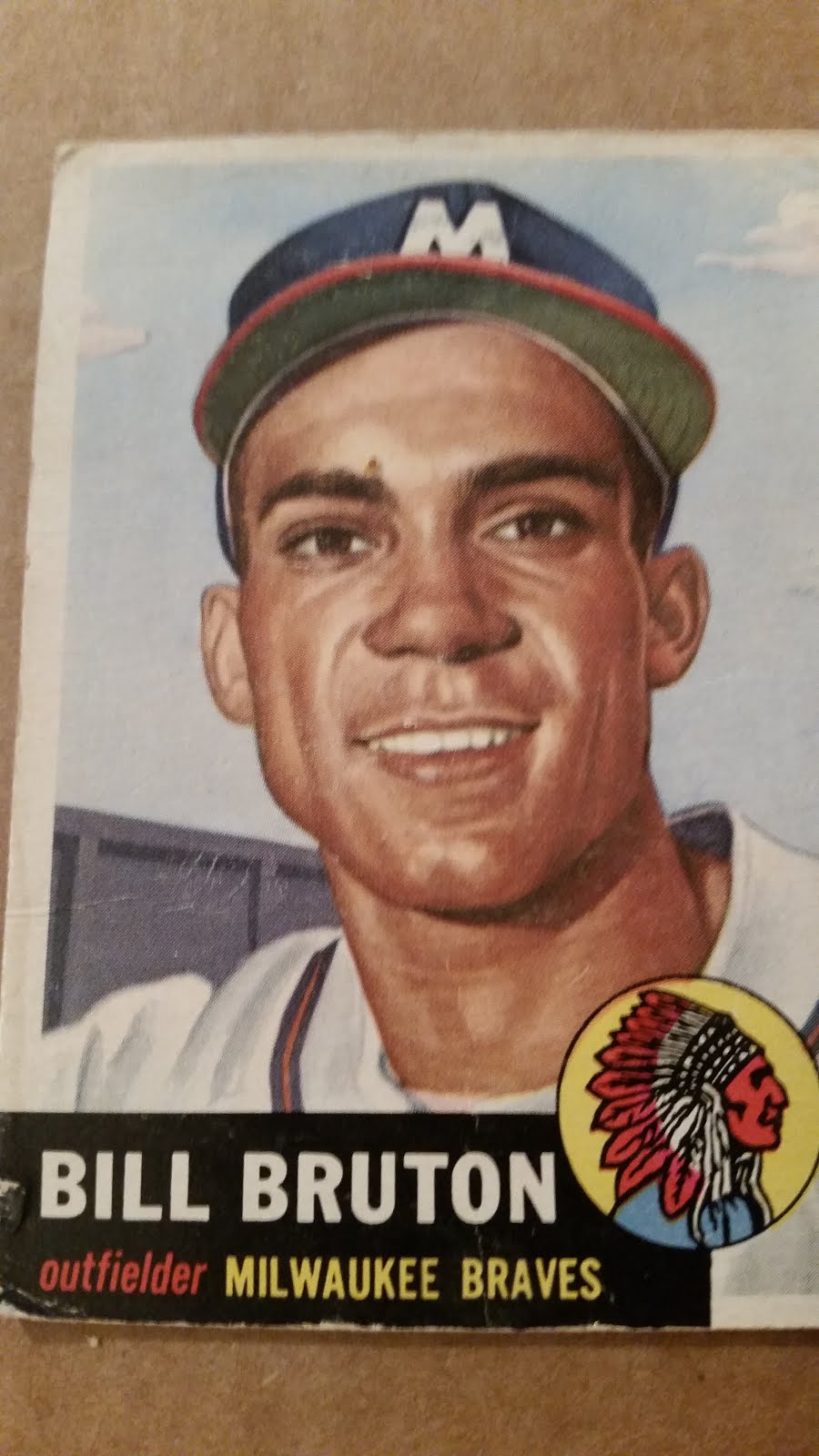
I had one 1962 Topps card before, of Robin Roberts, who was Dad's favorite growing up.  Since the whole 1987 Topps set is imprinted on me, I also have fond memories of the 1962 Topps "card that never was" featured on the Maury Wills turn-back-the-clock card.  I thought I would double the number of cards I had from 1962, and decided to get a standard-sized Bill Bruton.  I have two other Bruton cards, the 1953 Topps that I believe I pulled from a "grab bag" at Stale Gum, an old card shop in Newark, DE, in my very early collecting days, and a 1962 Post card I got several months ago.  The 1953 Topps doesn't fit in the pages at the front of the binder, and the 1962 Post is an oddball, so it doesn't fit thematically at the front of the binder. 

Bruton is a favorite for a few reasons: like me, he's a Delawarean.  He was one of MLB's early black players.  I've always been a fan of the base stealers, and he led the NL in steals his first three seasons.  And his personal story is interesting, that he got into playing ball late, and left early: he might have been able to keep playing a while longer, but retired when he got an offer to be an executive at Chrysler.
Hank Aaron.
Al Kaline.
Man, these 1967 Topps cards are beautiful.  This is my first good Al Kaline card.  I'm not an American League guy, but I did want to get some decent representation of the legendary Tiger into my collection, other than things like Baseball Immortals.  It's not my first good card of Aaron, but this is now my oldest card of him. 
Lou Brock.
And I'll close this out with another of the base stealing kings, the former career record holder, the great Lou Brock.  I have a handful of 1969 Topps in the binder already, but they're mostly standard cards (of Bob Gibson, Harmon Killebrew, and Juan Marichal), and also Al Oliver's rookie card.  I wanted to mix it up a little and got this, an All-Star card. 

Thanks for reading!  My posting is fairly infrequent these days as work is busy.  But I do enjoy when I have the time for a post.

Sunday, April 1, 2018

Delawareans: Some Recent Acquisitions

I've mentioned several times that I'm originally from Delaware.  It's a small state with a small population, so there aren't a lot of famous people or pro athletes from there.  When I was growing up, I knew that Judy Johnson was Delaware's only Hall-of-Famer.  That was before the internet, so if you hear something like that, it's hard to check.  Recently I tried to verify this and read somewhere that there were actually three Hall-of-Famers from Delaware; so, was I wrong to always think that Judy Johnson was the only one?  Who were these other two?  It turns out that Johnson was the only Delawarean in the Hall when I learned that fact in the 80s; the other two, Vic Willis and Bill McGowan, made the Hall in the 90s.
Vic Willis.
Pitcher Vic Willis was an early player, debuting with the Boston Beaneaters (the franchise that would become the Braves) in 1898.  He stayed with the Beaneaters through 1905, then moved to the Pirates, and in 1910 played with the Cardinals.  Willis led the National League with a 2.50 ERA in 1899, and pitched a no-hitter that year as well.  The Beaneaters were terrible after the Red Sox came into existence, and Willis went 12-29 in 1905 with only a 3.21 ERA, as he got terribly poor run support from the Beaneaters offense.  Moving to Pittsburgh in 1906, he posted a 1.73 ERA and a 23-13 record.  He continued to pitch well, including a 22-11 record with a 2.24 ERA in 1909 as the Pirates won their first World Series.  He died in 1947; the Veterans Committee put him in the Hall in 1995.

Needless to say, there aren't many cards of him.  When I went to COMC to look, I found that there are some old tobacco cards.  I don't collect tobacco cards, though, and am not really interested in starting.  There are also reprints of tobacco cards.  Not terribly compelling, in my view.  More up my alley is this standard-sized card, a 2012 Panini Cooperstown Bronze History card, of his Hall of Fame plaque, numbered 341/599.  This is still an outlier in my collection, since I barely have any cards post-1994.  With this (and another card at the bottom of this post), I now have exactly 20 cards manufactured after 1994 out of approximately 30,000 cards in my collection.
Bill McGowan.
Umpire Bill McGowan made the Hall via the Veterans Committee in 1992.  He worked American League games starting in 1925, continuing for 30 seasons, and umpired 8 World Series and 4 All-Star Games.  McGowan's Hall of Fame plaque says that he "introduced colorful style with vigorous, agressive gestures," and that he didn't miss working an inning for a 16-year stretch.  McGowan also founded an umpire school.

When I looked for a card of him, I found two options: the Conlon Collection, and the Panini Cooperstown Bronze History plaque card.  I figured since I was getting the Panini card for Willis, I should get something different for McGowan, and of course it's good to have a card with a photo of the guy, too.  There are a couple of different Conlon cards of him; this one, from 1993, explains that his nickname came from using an undersized chest protector.
Chad Kuhl.
Other than Hall-of-Famers, there are, of course, other players from Delaware.  Next Sunday I'll feature some cards of other Delawareans that have been in my collection for many years: Dave May, Chris Short, and others.  But this post is for these recent acquisitions, and other than Willis and McGowan, I picked up this card of Chad Kuhl recently.  Kuhl intersects my various interests, since he is a Pirate in addition to being a Delawarean.  In two seasons with the Pirates so far, Kuhl has put together a 13-15 record with a 4.30 ERA.  The Bucs have a shaky rotation, and there's some hope that the young pitchers, Kuhl included, will demonstrate some growth this season.  Kuhl's first start of 2018 is scheduled for later today, the night game of the double-header.  Here's hoping for a solid year!

Tuesday, January 9, 2018

Recent Acquisition: 1976 Shakey's Pizza Judy Johnson

As I've mentioned a few times, I am a Delawarean.  There aren't many baseball greats from Delaware.  Growing up, I knew there was exactly one Hall-of-Famer from Delaware, Judy Johnson.  That was true at the time, in the 80s; a couple more Delawareans made the Hall in the 90s. 
1976 Shakey's Pizza Judy Johnson.
There aren't many cards available of Judy Johnson.  He played his whole career in the Negro Leagues, mainly with the Hilldale Club and with the Pittsburgh Crawfords, and a little with the Homestead Grays.  I searched COMC for his cards, and was delighted to find this 1976 card from Shakey's Pizza.

There aren't great stats available for all the years of the Negro Leagues, so I won't comment on his hitting.  Johnson was known as a great defensive third baseman and a leader on the field.  After retiring as a player, he did work in some capacities for  MLB clubs, mainly as a scout.  He was responsible for signing Bill Bruton, whom I've posted about a few times, and who later became Johnson's son-in-law.
1976 Shakey's Pizza Judy Johnson card back.
I don't think I ever ate at a Shakey's Pizza.  There was one in Newark, DE, where I grew up, but my family never went, as far as I remember.  When it closed, the location became an Arby's.  Looking around the internet, I see that Shakey's still exists, but it's mostly a West Coast thing these days.  The card back is advertising the Seattle-area Shakey's, so perhaps these cards were an initiative of a Seattle-area franchisee, or something.
Baseball Immortals Judy Johnson.
The only other card I have of Johnson is this Baseball Immortals card.  There must not be many photos of him as a player, since Baseball Immortals went with a drawing instead.

My school bus sometimes went past Judy Johnson park in Wilmington.  When Wilmington built a minor league stadium in the early 90s, there was some pressure to name it after him.  Instead, they named it Daniel S. Frawley Stadium, after the (white) mayor who wanted it built.  They did compromise and name the field after Johnson.  So we have the complicated name, Judy Johnson Field at Daniel S. Frawley Stadium.  The stadium is home of the Wilmington Blue Rocks of the Carolina League, a Royals Class-A affiliate.

Thursday, January 4, 2018

Recent Acquisitions: Five 1962 Post Cards (Bruton, Killebrew, Clemente, Roberts, Ashburn)

I recently purchased five cards from the 1962 Post set.  As I mentioned in my last post, at this point in my life as a collector, I am interested in representing different sets in my collection rather than collecting the whole sets.  These five cards from 1962 Post are enough to accomplish that goal, while adding cards of some favorite players.
Bill Bruton.
One of my favorite cards is my 1953 Topps Bill Bruton, which I pulled from a "grab bag" at Stale Gum, the local card shop in Newark, DE in the mid-1980s.  Bruton is a fellow Delawarean, and was a prolific base stealer in his day.  It's nice to have a second card of him.
Harmon Killebrew.
I mentioned in the previous post that I always appreciated Harmon Killebrew as one of the few players to have more home runs than Mike Schmidt.  When Schmidt retired, that list was just Hank Aaron, Babe Ruth, Willie Mays, Frank Robinson, Harmon Killebrew, and Reggie Jackson.  In the post-steroids era the current all-time home run list is meaningless to me, but those older guys were the real thing.
Roberto Clemente.
Here we have another Clemente card, which I appreciate for calling him Roberto, not Bob.  He was something special, and it's nice to have a card from early in his career.  He had 1,062 career hits when this card was printed, about 1/3 of his career total of 3,000.
Robin Roberts.
I write a lot about Robin Roberts and Richie Ashburn, since they were Dad's favorites when he was little.  It's nice to add more cards of them, and this Roberts is even when he was still with the Phillies.  The card does note that his contract was sold to the Yankees, but I like that it shows him in a Phillies hat, unlike his 1962 Topps.
Richie Ashburn.
The Ashburn, by contrast, is after he left the Phils and moved to the Cubs; he was traded in January, 1960.  My only other good Ashburn card is the 1951 Bowman I bought in November.  Otherwise, all I have of Ashburn are things like Pacific cards.

I really couldn't be happier with these 5 cards, both so that the old Post cards are now something I have in my collection, and to buttress my small collections of these 5 players.  For cards from the early 60s of some great players, these Post cards were really quite affordable, too.

Monday, January 1, 2018

Happy New Year, Blog Note, and Favorite 2017 Card

Happy New Year!  Let's hope that some good things happen in 2018.  If we stick to just baseball, that means, for me, hoping that the Pirates keep McCutchen, stay healthy, and continue to develop their pitching.

Now, a note about the blog.  I said before, in my 100th post, that I don't think I can maintain my pace of daily posting without running out of material.  When I started this blog in August, I set a goal for myself of daily posts for 3 months.  When 3 months came and went, I didn't want to slow down, and decided to keep posting daily for a bit longer.  I made it through the end of 2017, but now I think it's time to shift down a bit.  Starting tomorrow, I'll be posting 4 times a week, on Tuesdays, Thursdays, Saturdays, and Sundays.

As long as I'm talking about the blog itself, let me say that I so appreciate everyone who has taken the time to read.   I started this blog to record stories about the baseball cards that I loved as a kid, and since then I've also discovered the joy of using internet commerce to round out my collection.  I love sharing both my old stories and cards and my new additions, and I've enjoyed discovering all the other card blogs that are out there (and have been out there for years).  It's very gratifying to  participate in the conversation, to be a part of a community of cardbloggers, and to know that there are people out there listening.

Now, since this is indeed a card blog, I think I should have a card in each post.  So I thought I would add my favorite card of 2017, as other cardbloggers have been doing.  That's a bit hard for me, though, since I don't focus on modern cards.  I have a very small number of cards (only 17, I think) that are post-1994.
2017 Donruss Paul Goldschmidt.
Of those 17 are 12 2017 Donruss cards that I bought at a dollar store recently.  This Goldschmidt is easily my favorite, for a personal reason -- from the back of this card, I learned that Goldy was born in Delaware (like me).

So, that's it for 2017.  Again, Happy New Year, and thanks for reading.  The new posting schedule starts tomorrow.

Thursday, October 26, 2017

A Trip to the Dollar Store: 2016, 2017 Donruss

My collection really ends at 1994.  Sometime around 1991, I switched to primarily collecting comic books, so the 1992-1994 part of my collection is much thinner than the 1987-1991 part.  Until I made a recent trip to the dollar store, I had exactly one post-1994 card in my collection, as I wrote about in a post about my first trade in many years.  At the dollar store, I bought four packs with four cards each in them, so I guess I now own exactly 17 post-1994 cards.  Those packs were 3 packs of 2017 Donruss cards, and 1 pack of 2016 Donruss cards.  I'm posting here my 6 favorite of these 16 Donruss cards; I'll say that I was skeptical that I would like Donruss cards without the team logos, but I do think these are nice cards.
2016 Donruss Mike Trout.
I hear this Mike Trout guy is a big deal.  I really only watch the Pirates lately, so I don't know much about other teams.  It's not like 1987, when I knew who all the league leaders were all the time.  I see, looking him up now, that he's a six-time All-Star, a two-time AL MVP, and was AL Rookie of the Year.
2017 Donruss Duke Snider.
Duke Snider I know about.  I have one good card of Duke Snider, which I'll post soon.  I have a handful of cards like this of Snider, printed long after his career.
2017 Donruss Anthony Rizzo.
This year wasn't as bad, but last year, the Cubs completely dominated the Pirates.  I remember the names of some of the Cubs from this hard-to-watch experience which culminated in the Cubs as champions.
2017 Donruss Paul Goldschmidt.
Paul Goldschmidt I have also heard of, and I know he's a slugger.  The best thing about this card is that I learned from it the Goldschmidt is a Delawarean!  Like me, he was born in Wilmington, DE.  I looked him up and learned that he was actually raised in Texas, but I don't care -- I will add him to the list of famous Delawareans I'm aware of.
2017 Donruss Bryce Harper.
Bryce Harper I mainly know of from his T-Mobile commercials.  I guess my favorite Washington National is Jayson Werth, whom I remember from the Phillies' 2008 World Championship team.
2017 Donruss Buster Posey.
Buster Posey I've heard of, but mainly from the Buster Posey rule about catchers and baserunners and blocking the plate.

These are 6 of the 16 cards from the 4 packs I bought at the dollar store; it's entirely possible that some of the other 10 cards have important, excellent players, but I know so little about modern baseball that I didn't recognize them.  I know that I didn't get any Pirates.  Despite my feeble knowledge these days, and despite the lack of logos, like I said, I thought these are nice cards.

Friday, October 20, 2017

Burger King Cards -- Part 2 of 2

Following up on yesterday's post on Burger King cards, I am highlighting today the 1980 Burger King Phillies set.  This set had a big impact on me growing up -- I remember getting a bunch of these in 1980 despite being only 4 years old, and I remember the Phillies winning the World Series, at least vaguely.  Many of these were legendary guys for the Phillies -- you have to understand that the Phillies existed 97 years without a championship, and 77 years if you count since the World Series started. These were the guys that did the impossible and ended that drought.  Boone, Trillo, Bowa, Maddox, McGraw, Rose, Schmidt, and Carlton were all named to the Phillies Centennial Team in 1983. 

The set is imperfect in commemorating that World Championship team, mainly because 1980 cards reflect the reality of 1979, and the 1979 Phillies had some differences.  Some players are left out -- if you had a similar set in 1981, you would want to feature Bob Walk, for example, who was a reliable starter for the Phils as a rookie in 1980.
1980 Burger King Phillies checklist card, and Dallas Green and Bob Boone.
I already had a set of these in my collection, but I couldn't resist ordering more from ebay recently.  I got a box of 49 unopened packs (3 cards per pack) for about $30.  I opened 15 packs before I got a complete set, leaving me with 34 unopened.  These are thin cello packs, and each pack has one player and the checklist visible.  My unopened packs show 20 of the 22 players (missing Greg Gross and Lonnie Smith).  The new complete set is in great condition, whereas the condition of my old set is varied, with some of them being quite beat up.
34 unopened packs of 1980 Burger King Phillies.
While I had a complete set of the 22 cards, I didn't have the checklist, pictured here with "The King" of Burger King himself.  I remember the checklist card clearly, though, from my childhood -- since you get one checklist per pack, we had several of them around when I was little.  It's great to have it again, and since I opened 15 packs, I have 15 of them.

I won't comment on all of the players, but I am showing them all.

Dallas Green managed a few other teams over the years, but never had the same success as with the Phillies.  I like to point out MLB figures who are Delawareans, and Dallas Green is one.  His time with the Phillies got him the much-coveted honor of being in the Delaware Sports Hall of Fame.
Keith Moreland, Pete Rose, Manny Trillo, Mike Schmidt, Larry Bowa, and John Vukovich.
What is there to say about Pete Rose?  I didn't know in the 80s about the things he had done/would do that would disgrace him.  All we knew back then was that no one played baseball harder.  When the Phillies signed him, they had lost the playoffs for three years in a row, 1976-1978.  They meant business, and with Rose added to the team, they won the 1980 World Series, played in a divisional series in 1981, and won the pennant in 1983.

Manny Trillo was a great second baseman.  He was only with the Phillies from 1979 through 1982, but in those years he won three Gold Gloves and two Silver Sluggers.  He was the NLCS MVP in 1980.

What is there to say about Mike Schmidt?  He's the greatest.  I sent one of my spare Schmidt cards from this set to PSA for grading.

As far as I can tell, John Vukovich isn't related to former Phillie George Vukovich, or to the pitcher Pete Vukovich.  I always assumed they were brothers or something, but I guess not.  John Vukovich became a coach, interim manager, and front-office executive for the Phillies later.  He was a fixture with the team until his death from brain cancer.
Bake McBride, Garry Maddox, Greg Luzinski, Greg Gross, Del Unser, and Lonnie Smith.
Bake McBride was the 1974 NL Rookie of the Year with the Cardinals.  He had a lot of injuries over the years, but managed to produce some solid years for the Phillies.

I don't like to miss an opportunity to repeat Harry Kalas' line about Garry Maddox, "Two thirds of the earth is covered by water, the other one third is covered by Garry Maddox."  Secretary of Defense, indeed.  The Phillies were lucky to have him.

Greg Gross and Del Unser both seemed to specialize in pinch hitting.  Unser tied the record for pinch home runs in consecutive at-bats with 3 in 1979.  Gross is fifth on the all-time pinch hits list, with 143.
Steve Carlton, Larry Christenson, and Nino Espinosa.
The set is in order by position; it starts with the manager, then catchers, first base, second base, third base, shortstop, infield, outfield, then starting pitchers, then relief pitchers.  Within each category, it's alphabetical -- Boone then Moreland as catchers, for example.  So, for starting pitchers, we have Steve Carlton, Larry Christenson, Nino Espinosa, Randy Lerch, and Dick Ruthven.

Even though the Phillies won the 1980 World Series and the NL East in 1976, 1977, and 1978, they really had an off year in 1979.  The team finished 4th with a 84-78 record.  Carlton, naturally, was the ace, and had an 18-10 record.  Espinosa was 14-12, Lerch was 10-13, Ruthven was 7-5, and Christenson was 5-10.  Not included in the set is Dickie Noles, who had 14 starts with a 3-4 record.
Randy Lerch, Dick Ruthven, and Tug McGraw.
Tug McGraw was much beloved in Philadelphia, as a result of his time as a closer with the Phillies from 1975-1984.  McGraw also was a fixture in Philadelphia, like Vukovich, until McGraw also died of brain cancer.
Ron Reed and Kevin Saucier.
The last two cards are of Ron Reed and Kevin Saucier.  Reed pitched from 1966 through 1984, both starting and relieving, with a record of 146-140, an ERA of 3.46, and 103 saves.  Reed was a two-sport guy, and also played two seasons in the NBA with the Pistons, playing in 119 games from 1965-1967, averaging 8.0 points per game.  Saucier was in the majors 1978-1982, retiring when he had control problems, and then became a scout.

Friday, August 18, 2017

From My Collection: 1990 Donruss Delino Deshields Rookie Cards

Since I've rejoined the baseball card collecting world a few weeks ago, I've read whatever articles and blog and forum posts I could find about the "junk wax" era.  I only now discovered that my era of collecting was known as the junk wax era.  In hindsight, it makes sense.  In some people's comments, I've found people joking about how (not) valuable certain rookie cards which were hot at the time are, such as Todd Van Poppel or Delino Deshields. 
Two 1990 Donruss Delino Deshields Rated Rookie cards.
Having been largely away from baseball since 1994, I just looked up online whatever became of Deshields.  I certainly remember him from the time, though, because he was a big deal locally -- like me, Deshields is a Delawarean.  Delaware isn't a big state (about 100 miles long by 20 miles wide), and he came from the opposite end (I'm from Newark at the top of the state and he's from Seaford at the bottom of the state).  Not many Delawareans make the big leagues, so it's always something noteworthy.  According to Wikipedia and Baseball Reference, he ended his career with over 1500 hits and just over 500 RBI, and with a .268 average, in 13 major league seasons, and was once traded for Pedro Martinez.

Tuesday, August 8, 2017

From My Collection: 1953 Topps Bill Bruton

When I collected cards starting in 1987, the card shop we went to in Newark, DE was called Stale Gum.  At Stale Gum, one thing I frequently purchased was a Grab Bag -- I think it was about $1, and you would get a few random cards, not all bad.  I think that's how I came upon this card, my 1953 Topps Bill Bruton.  If I didn't have this card, I would never have heard of Bruton.  This is one of my favorite cards, for three reasons: it was the first card I got from the 1950s (right now, my collection of about 30,000 cards contains only 12 cards from the 1950s), Bruton was one of MLB's early black players, and he was (like me) a Delawarean.  From what I've read about Bruton, he was a leadoff hitter and a base stealer, something like the 1950s version of Vince Coleman.  A good article about Bruton is available from SABR.

1953 Topps #214 Bill Bruton