Thursday, January 18, 2018

From My Collection: Kevin Costner

A few months ago, I posted about my Pacific Eight Men Out set.  Today we have this Field of Dreams card featuring Kevin Costner, which is my only other baseball movie card.
Kevin Costner.
Field of Dreams was released in April, 1989, when I was finishing up 8th grade.  I liked the movie when it came out, and soon after that I found the novel at my school's book fair, when I was in 9th grade.  It wasn't completely obvious at first that the novel and the film were the same story, since the book was called Shoeless Joe and it wasn't labeled as "the inspiration for the movie Field of Dreams" or anything.  I had my suspicions, though, both because Shoeless Joe Jackson was so integral to the Field of Dreams story, and because I remembered that the last name of the book's author, Kinsella, is the same last name as Kevin Costner's character in the movie.  Sure enough, it was the novel the film was based on.  Kinsella wrote another novel, the Iowa Baseball Confederacy, and which was mentioned on the book cover.  I thought at the time I'd like to check out this other book, but it was harder to get some books in the pre-internet era; you'd have to try to special order from a bookstore if they didn't already have it, and I wasn't that motivated to read it.
Kevin Costner card back.
As the back makes clear, this card promoted the idea of ordering Field of Dreams on Pay-Per-View on cable.  I guess ordering movies that way is something we could still do (we do have cable, since it's the only way I can get the Pirates games), but we stream via Amazon and Netflix instead.

As far as I can tell, this card isn't available on COMC.  There is one on eBay, with a Buy-it-Now price of $50 (but it's graded and slabbed, in near-perfect condition).  Perhaps the card is a bit rare?  I picked it up at a show a long, long time ago, and I don't think I paid much of anything for it.  I suspect it was thrown in on another purchase.

Tuesday, January 16, 2018

On Andrew McCutchen

As a Pirate fan, it's hard to see the end of the McCutchen era in Pittsburgh.  I wasn't watching his whole career like some other bloggers or fans.  Instead, I only reconnected with the Pirates recently.

Let me start at the beginning -- I grew up in Delaware, in the Philadelphia media market.  Schmidt and the 1980 Phils were legends; their World Series win happened when I was about to turn 5 years old, and I barely remember anything except how excited everyone was.  I only followed baseball loosely after that, until the summer of 1987.  Then my friends and I started buying packs of 1987 Topps baseball cards at the local 7-Eleven.  I was 11 years old, and started dedicating most of my waking moments to following baseball.  I read through a bunch of statistics and decided the Pirates would be my favorite team; I was being a bit contrarian, because literally everybody else I knew was a Phillies fan.  I sensed they were going somewhere, though -- they had Barry Bonds, Bobby Bonilla, and Andy Van Slyke.  Over the next several years I got to see them develop and eventually win three straight division championships, just missing a chance at the World Series due to former Pirate Sid Bream.  In 1993, I left for college.  Back in those days college kids didn't get cable in the dorms, and the internet barely existed.  I didn't watch much of the 1993 season, or 1994.  When the strike happened in 1994, it was easy to just give up on the game.  I stopped following baseball entirely.
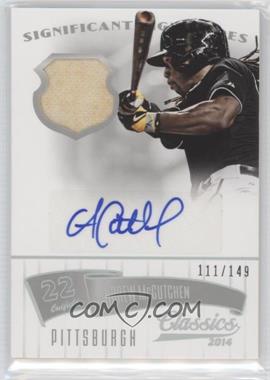
2014 Panini Classics - Significant Signatures Materials - Silver Jerseys #3 - Andrew McCutchen /149 - Courtesy of COMC.com
2014 Panini Classics - Significant Signatures Materials - Silver Jerseys #3 - Andrew McCutchen /149
In the following years, I occasionally watched the World Series, but nothing else.  I saw Jim Leyland, Bobby Bonilla, Darren Daulton, and others win with Marlins in 1997.  I didn't care about all the years the Yankees won.  I remember Randy Johnson and Curt Schilling leading the Diamondbacks to victory in 2001, Troy Glaus and the Angels in 2002, the Marlins again in 2003, the Red Sox breaking their curse in 2004, and the Phillies getting their second championship in 125 years of existence in 2008.  I don't think I watched any other years.

Then my son was born in the summer of 2015.  My wife had maternity leave in the summer, and I had paternity leave in the fall.  My son and I spent a lot of hours alone together that fall.  I bought the MLB online package (we were out of market for the Pirates back then) and started watching the Pirates again, after over 20 years of absence.  It was easy to be a fan again, what with time to watch the games again, and with McCutchen leading the Bucs to a 98-64 record and what was their third recent playoff experience.

The 2016 and 2017 seasons weren't as successful and were harder to watch, but it was still a lot of fun.  McCutchen was the key to the team both these years, and seeing him rebound in 2017 was awesome.  It has been frustrating as the management has decided not to make moves that would lead to better outcomes, and now that they're disassembling the team that drew me back into baseball.

I've said before that I only own 17 cards from post-1994.  One of those is a George Foster that I got in a trade with Greg from The Collective Mind.  The other 16 are recent Donruss cards I bought at the dollar store (four packs of four cards) this past year.  I did just recently buy three more modern cards, though; they're in my COMC account, so I don't actually have them yet, and I wasn't going to post about them until I received them.  But I decided to put up the McCutchen that I bought, using a COMC picture.  Until now, the only autographed cards that I've had were signed at card shows that Dad and I attended together back in the day.  I don't expect to get many modern cards, and this includes not looking for many modern autographed cards.  But I wanted one of McCutchen, who more than anyone else in MLB is why I'm watching the Pirates again.  I bought one of the above 2014 Panini Classics Significant Signatures Materials cards a few weeks ago; the one pictured isn't mine (which is numbered 10/149) but is another for sale at COMC.  I was hoping to be watching McCutchen as a Pirate for a long time, but that isn't how baseball works these days.  Instead, this card will commemorate my return to baseball fandom.

Recent Acquisitions for My Player Collections: 5 Stargells and 1 Schmidt

Last month I acquired a bunch of Willie Stargell and Mike Schmidt cards for my player collections.  I thought I would show the Stargells today, but I'm also including one of the Schmidt cards for comparison.  I feel like I say this a lot, but I am loving buying cards, especially oddballs really, online -- when I was collecting in the 80s, you'd be lucky to come by just a fraction of this stuff at the local card shops or at shows, where the current product of the overproduction era was most dealers' emphasis.
1989 Starting Lineup Baseball Greats Willie Stargell.
I only own one Starting Lineup figure, which is of Von Hayes and was given away at one of the many Phillies games that Dad and I attended.  It's nice to have this card, but it does make me think that I might want to track down the figure, too.  I see on eBay that it was a set of Stargell and Clemente, and there are some available still in the package; that's a very difficult to resist combination.
1977 Topps Cloth Sticker Willie Stargell.
I've said before that I don't remember ever knowing about the 1977 Cloth Stickers set until this past summer, when I rejoined the collecting world.  My earlier approach, upon discovering their existence, might have been to want the whole set.  Now, instead, I just want a few of them in my collection to represent the whole.  This Willie Stargell will do that, in the player collections portion of my secondary binder.  In the oddball-heavy section of my main binder, I have a cloth sticker that I recently picked up of Dave Cash, and I plan to get a couple more.
1975 Hostess Willie Stargell.
The only Hostess cards I originally had in my collection were from 1993.  I think those are great cards and I plan to post about them sometime, but the 1970s versions are a whole nother thing, as they say.  I'm not planning to pick up every Hostess card of every player I'm developing player collections of, but these do add a nice dimension to the collection, with there being fewer oddballs available from the 70s than there were later.
1969 Milton Bradley Willie Stargell.
1969 Milton Bradley Willie Stargell card back.
I'm so happy to add this 1960s oddball to my Stargell collection.  From what I gather just looking at the card, this was a game similar to the 1968 Topps game or the 1951 Topps red backs/blue backs, except played with dice in addition to the cards.  I've never played any of these games, although I admire how many times Topps (and Milton Bradley) tried to make a go of them, especially with Topps including the game again on the backs of the 1978 cards.
1984 Milton Bradley Championship Baseball Mike Schmidt.
1984 Milton Bradley Championship Baseball Mike Schmidt card back.
I said I was including one Schmidt card for comparison, and this is it.  I guess Milton Bradley tried again with their cards-and-dice baseball game, and so I was able to pick up this 1984 Milton Bradley Championship Baseball card of Mike Schmidt.  For the cards, this time Milton Bradley teamed up with Topps, although we get the unusual circumstance of logo-less Topps cards; I guess it must have been cheaper for Milton Bradley that way.  Although the cards are from 1984, the card backs are in the same color scheme as 1983 Topps backs; maybe these were designed, if not released, around the same time as the 1983 set.  Comparing the two card backs, you see that the 1984 version of the game is a lot more detailed in terms of the dice rolls; the 1969 version only cared about what the total of the dice was, while the 1984 version gives different outcomes based on which numbers actually came up (so rolling a six and a three is a different outcome than rolling a four and a five in the 1984 version).  Speaking of rolling a four and a five, I had never heard of a "Texas League Single" before; it just means a blooper that lands between the infielders and the outfielders for a single.
1970 Kellogg's Willie Stargell.
Finally, we have this, a 1970 Kellogg's Willie Stargell.  I've posted several times about the fact that I found Kellogg's cards hard to come by at the local shops and shows in the 80s, and I'm having a great time picking up many more Kellogg's cards now than I ever originally had.  And this 1970 Stargell is the greatest one I've seen so far -- the clean design is great, it has the feel of its era, the old uniform with the vest/contrasting sleeves is awesome, and the young Stargell looks like he's about to go whack some monster home runs once the photo shoot is done.

That's it for my Stargell additions for now.  Maybe there will be more next month, and there are definitely more Schmidts I have to post soon.

Sunday, January 14, 2018

Sets in My Collection: 1988 Topps Woolworth Baseball Highlights

I've been doing these posts of 1980s boxed sets for months now, and I think this is it: the last one in my collection.  It's a Topps Woolworth Baseball Highlights set from 1988, recapping the 1987 season.  While I had watched baseball casually before, 1987 was the first year I followed baseball religiously, so the 1987 season meant a lot to me.
Don Baylor.
Hit by many pitches.
The stats on the back of this card, declaring Don Baylor to be the MLB record holder for being hit by pitches, don't match what's available now on the internet.  Instead, a quick search shows that Hughie Jennings and Tommy Tucker would have been ahead of Baylor at the time (Craig Biggio has surpassed Baylor since).  I suppose more reliable statistics are available now.
Mike Schmidt.
3B home run record.
I can't verify this as clearly as the hit by pitch record, but I believe it is accurate, even now, that Mike Schmidt is the record holder for home runs by a third baseman.  Almost all of his career home runs were hit while playing third base, since that is almost always where he played.
Andre Dawson.
1987 NL MVP.
Andre Dawson insisted on being signed by the Cubs, and went on to hit an awesome 49 home runs.  It was a great story all season.
Bert Blyleven.
Game 2 of the World Series.
I have some vague, early memories of the 1980 World Series, but I was only 4 years old (just about to turn 5) back then.  After that, I think 1987 was the first World Series that I watched.  It was great, going 7 games, and being (I think) the first World Series in which the home team always won.  It was Bert Blyleven's second World Series win, after helping lead the Pirates to the 1979 championship.  In the DVDs of the 1979 series, it's stated that Blyleven had a reputation for never winning the big game.  His response, when questioned about that, was that he hadn't even played in the big game yet.  1979 put all that to rest, as he was instrumental for the Pirates.  He was a winner for the Twins again in 1987, as this card shows.
Don Baylor, again.
Game 6 of the World Series.
Here we have Don Baylor again, in the second of three consecutive World Series appearances, all with different teams.  He was on the 1986 Red Sox who lost to the Mets, and on the 1988 A's who lost to the Dodgers.  I'm glad his storied career includes a World Series win!
Kent Hrbek.
Game 6 of the World Series.
Here we have another card celebrating the Twins' victory in Game 6.  The previous one was for Don Baylor's 3-run homer which tied the score, and this one is for Kent Hrbek's go-ahead grand slam.  Hrbek is a Twins Hall-of-Famer and retired number who hit 293 home runs with them and was on both the 1987 and 1991 championship teams.  I love guys like this, who don't quite make Cooperstown, but mean the world to the local fans.
Kirby Puckett.
Game 7 of the World Series.
The 1987 World Series was my introduction to Kirby Puckett.  It was awesome watching him play.  Being NL fans on the east coast, we never saw Kirby in person (probably -- I did go to a handful of Orioles games, but I don't really remember who I saw play there).  It was fun seeing him again in the 1991 World Series, when the Twins beat the hated Braves (hated specifically because they beat my Pirates in the NLCS).

So, that's it for my Topps and Fleer boxed sets from the 80s.  I think I'll probably put up a post summing up what we've seen from these sets, but otherwise, my Sunday posts will move on to another topic.  Thanks for reading!

Saturday, January 13, 2018

Oversized in My Collection: 1986 Donruss All-Stars (Part 2 of 6)

This Saturday we're continuing with showing the entire set of 1986 Donruss oversized All-Stars; I showed cards 1-10 last week, and we have 11-20 this week.

Previously in this series: 1986 Donruss All-Stars Part 1 (1-10).
#11.  Lou Whitaker.
The first 18 cards are the starters, in the order of the lineup.  At #10 we had Rickey Henderson, a natural choice to bat leadoff for the AL.  Batting second was Lou Whitaker of the Tigers.  The 1986 All-Star set is based on the 1985 All-Star game which is influenced by the 1984 World Series, and Whitaker is one of two World Champion Detroit Tigers in the starting lineup (along with starting pitcher Jack Morris below).  The NL starting lineup, by contrast, had a whopping 5 of the NL pennant-winning San Diego Padres.

If you check you'll see that, with Morris' recent selection for the Hall of Fame, Whitaker is the only AL starter not in the Hall.  I hope that will be remedied in the near future!  The NL, by contrast, hardly had any Hall-of-Famers in its lineup (just Tony Gwynn and Ozzie Smith), but the NL won the game 6-1 anyway.  In the game, Whitaker went 0-for-2, flying out to right field both times he was up.
#12.  George Brett.
Batting third for the AL was third baseman George Brett, making his 10th of 13 consecutive All-Star appearances.  Brett went 0-for-1 in 3 plate appearances with one walk, and drove in the AL's only run with a sacrifice fly to score Rickey Henderson in the 1st inning.  I like that you can see his name on his uniform as G. Brett; I'm guessing the first initial is an artifact of his brother Ken having once played with him on the Royals.
#13.  Eddie Murray.
Batting cleanup for the AL was slugger Eddie Murray of Baltimore.  No one on the AL team had a good night, really, and that included Murray, who went 0-for-3.  This was the 6th of Murray's 8 career All-Star appearances.
#14.  Cal Ripken, Jr.
I sometimes wonder why the early 90s Orioles teams didn't do better, with players like Ripken, Brady Anderson, and Mike Mussina.  But the early 80s teams, with Ripken, Murray, and an aging Jim Palmer, did win the 1983 World Series.  In the game, Ripken went 1-for-3, with a single off Nolan Ryan in the 6th inning.
#15.  Dave Winfield.
Dave Winfield is probably my favorite player that I don't have a specific player collection for.  Winfield was a 12-time All-Star, and in 1985 also won one of his 7 Gold Gloves and one of his 6 Silver Sluggers.  He went 1-for-3 in the game, with a single off Nolan Ryan in the 5th inning.
#16.  Jim Rice.
Jim Rice is from Anderson, SC, where my wife and I once lived for three years, so I like him for that reason in addition to appreciating his career record.  Like most of the AL players, he didn't do much in this game, going 0-for-3 in 4 plate appearances, drawing a walk from Fernando Valenzuela in the 7th inning.
#17.  Carlton Fisk.
Batting eighth is the catcher, Carlton Fisk, of the White Sox, wearing that classic Sox uniform.  Fisk went 0-for-2 before being replaced.  His appearance in 1985 was the next-to-last of his 11 All-Star selections, with his last time being near the end of his long career in 1991.

If you look closely at the bottom of the Fisk card, you can see a production defect.  Rather than the card being completely flat, there is some crimping along the bottom edge.  The only other cards I've seen this on are a couple of my Cracker Jack Topps micro cards, which I did show in an earlier post (you can see the crimping much more clearly there, but it's the same type of thing as here).  I wonder if there was some kind of challenge to producing cards in non-standard sizes that led to these defects.
#18.  Jack Morris.
Closing out the starting lineup for the AL, we have pitcher Jack Morris batting 9th.  Morris never made it to bat, though, having been pulled in favor of Jimmy Key in the top of the 3rd inning.  Morris was the losing pitcher, having given up two runs (both earned) in 2-2/3 innings pitched, in what ended up being the AL's 6-1 loss to the NL.
#19.  Jose Cruz.
After the starters, the cards still appear in the order of the lineup.  If you remember card #1, it was Tony Gwynn, because he batted first for the NL.  Cruz was substituted in the 2nd inning for Tony Gwynn, so he took the first spot in the lineup, and he's the next card.  Cruz had three plate appearances, going 0-for-1 with 2 walks and a stolen base.  Then, he was replaced in the lineup with Tim Raines in the 9th inning, so Tim Raines is our next card.  This was the second and final All-Star appearance for Cruz in his career.
#20.  Tim Raines.
At #20 is Tim Raines, who was making the fifth of his seven consecutive All-Star appearances.  Raines, in his one plate appearance in the 9th inning, was walked by Dan Petry, moved to second when Petry also walked Jack Clark, and then scored when Willie McGee hit a ground-rule double.  That was the last run of the game, putting the NL up 6-1.

Next Saturday, we'll continue to relive the 1985 All-Star game by featuring cards 21-30 from the set!

Thursday, January 11, 2018

My Ill-Fated 1979 Topps Project, and My Acquisition of a 1979 Topps Set

I've said before that my earliest card memories are of some 1979 Topps we had around the house.  The 1979 John Candelaria in a prior post is certainly one of those very cards.  When I was originally collecting, 1987-1994, I made a half-hearted effort to put together a 1979 Topps set.
Most of my original 1979 Topps cards.
I collected a bit more than 10% of the set; I didn't count exactly how many different cards, but it's around 80-90 or so.  Pictured above are most of these 1979 Topps cards that I had.
Manny Trillo and Al Oliver.
 Of course, I have some of my original 1979 cards in my main binder, and those are kicked off by two sentimental favorites, Manny Trillo and Al Oliver.  Trillo was a star with the Phillies from 1979 through 1982, which was long enough to win the 1980 World Series, make the All-Star team twice (out of 4 career All-Star appearances), and win 3 Gold Gloves at second base.  Oliver was a long-time Pirate who was the starting center fielder when they won the 1971 World Series.  Of his 2743 career hits (in a career surely shortened by the owners' collusion against free agents), 1490 were with the Bucs, placing him 12th on the Pirates all-time hits list, just ahead of Dave Parker and Andrew McCutchen.

A binder page featuring 1979 Topps.
The next page of 1979s in my binder has Thurman Munson, Dennis Eckersley, Victory Leaders (Ron Guidry leading the AL with 25 and Gaylord Perry leading the NL with 21), Dale Murphy, two of Rod Carew, two of Reggie Jackson, and Steve Carlton.
Another binder page featuring 1979 Topps.
Continuing to the next page, we have Gary Carter, two of Joe Morgan, Johnny Bench, Willie McCovey, Rollie Fingers, Lou Brock, and two of Carlton Fisk. After that (not pictured) are the final two 1979 cards in my binder, Jim Palmer and Tommy John.

All of the cards pictured (or described) so far are from my original period of collecting and aren't recent acquisitions.

I didn't have a great way to go about collecting a set back in the day -- I don't think the card shops in town had a lot of 1979 commons.  I picked up star cards when I could, but I didn't devote myself exclusively to the pursuit of 1979 cards, so I didn't get all of the stars, even.  The Ozzie Smith rookie was too expensive for me.  Locally, Mike Schmidt cards from the 70s commanded a premium.  So, when I quit collecting after my first year of college, I was still pretty far from my goal.
My recently acquired 1979 Topps set.
So, now that I'm collecting again?  I definitely wanted to get a 1979 Topps set.  And, that's what I've just done.  I used most of my January card budget to order a complete set from eBay.  I had considered collecting the whole set instead of buying it all at once, but it just isn't worth enough, I think.  The whole set cost me just $75, and I'm pretty sure that it would cost more to collect the cards individually, not to mention the time and effort it would take.  The condition of the cards in the set isn't perfect, but they're plenty good enough for me.
Five cards the seller put into semi-rigid holders: Rose, Brett, Ryan, Smith, and Molitor.
The previous owner put five of the best cards in semi-rigid holders, separated out from the rest of the bulk.  Ozzie Smith's rookie card is really the most valuable, I think, but there's also Pete Rose, Nolan Ryan, George Brett, and Paul Molitor.

I'm really glad to have the complete set -- even though it isn't nearly the most interesting Topps set of the era, and even though I didn't end up piecing it together myself, owning it accomplishes a childhood dream.  Coming soon on the blog will be a series of posts highlighting some notable cards from the set, now that I have all of them.

Tuesday, January 9, 2018

Recent Acquisition: 1976 Shakey's Pizza Judy Johnson

As I've mentioned a few times, I am a Delawarean.  There aren't many baseball greats from Delaware.  Growing up, I knew there was exactly one Hall-of-Famer from Delaware, Judy Johnson.  That was true at the time, in the 80s; a couple more Delawareans made the Hall in the 90s. 
1976 Shakey's Pizza Judy Johnson.
There aren't many cards available of Judy Johnson.  He played his whole career in the Negro Leagues, mainly with the Hilldale Club and with the Pittsburgh Crawfords, and a little with the Homestead Grays.  I searched COMC for his cards, and was delighted to find this 1976 card from Shakey's Pizza.

There aren't great stats available for all the years of the Negro Leagues, so I won't comment on his hitting.  Johnson was known as a great defensive third baseman and a leader on the field.  After retiring as a player, he did work in some capacities for  MLB clubs, mainly as a scout.  He was responsible for signing Bill Bruton, whom I've posted about a few times, and who later became Johnson's son-in-law.
1976 Shakey's Pizza Judy Johnson card back.
I don't think I ever ate at a Shakey's Pizza.  There was one in Newark, DE, where I grew up, but my family never went, as far as I remember.  When it closed, the location became an Arby's.  Looking around the internet, I see that Shakey's still exists, but it's mostly a West Coast thing these days.  The card back is advertising the Seattle-area Shakey's, so perhaps these cards were an initiative of a Seattle-area franchisee, or something.
Baseball Immortals Judy Johnson.
The only other card I have of Johnson is this Baseball Immortals card.  There must not be many photos of him as a player, since Baseball Immortals went with a drawing instead.

My school bus sometimes went past Judy Johnson park in Wilmington.  When Wilmington built a minor league stadium in the early 90s, there was some pressure to name it after him.  Instead, they named it Daniel S. Frawley Stadium, after the (white) mayor who wanted it built.  They did compromise and name the field after Johnson.  So we have the complicated name, Judy Johnson Field at Daniel S. Frawley Stadium.  The stadium is home of the Wilmington Blue Rocks of the Carolina League, a Royals Class-A affiliate.