Saturday, March 24, 2018

Starting Lineup Talking Baseball: NL All-Stars

In November 1988, I turned 13, and for my birthday, I received the electronic Starting Lineup Talking Baseball game.  It came (either built in or with a cartridge, I'd have to check -- the game is still at my Mom's house) with two teams you could play, the AL All-Stars and the NL All-Stars.  You could buy additional cartridges, and I believe I only ever got one of these, with the Pirates, Phillies, and Mets.  Each team that you could play came with baseball cards.  The front of the card says that the copyright is held by KPT; this appears to stand for Kenner Parker Toys, as the game was branded Parker Brothers, which by then had been merged with Kenner, maker of the Starting Lineup figurines.
Eric Davis.
Eric Davis card back.
You can see from the plain red cap on the head of Eric Davis that the cards are logo-less.  The card backs are pretty plain, with a few lines of stats, the position played, and a few other pieces of information.  For some reason the AL team has 20 players and the NL team has 19.  Computer memory used to be very limited, so perhaps they could only fit 39 players onto whatever storage system they used.

Eric Davis was a big deal at the time, and his 1987 stats shown here make clear why -- 37 home runs was a lot back then, and was fourth in the NL at the time.
Todd Worrell.
Steve Sax.
In 1986, Todd Worrell won NL Rookie of the Year with his league-leading 36 saves.  He followed that up in 1987 with 33, which was third behind Steve Bedrosian and Lee Smith.  Steve Sax was still with the Dodgers back then, and had his fielding problems, but was still something of a star.
Jody Davis.
Andre Dawson.
Jody Davis, catcher for the Cubs, was an All-Star and Gold Glove winner in 1986.  In 1987, Andre Dawson of the Cubs had a monster year, leading the NL with 49 home runs and 137 RBI, becoming the NL MVP, making the All-Star team, and winning both the Gold Glove and Silver Slugger.  It's too bad that all this talent didn't translate into more success for the Cubs, who finished in last place with a 76-85 record in 1987.
Ozzie Smith.
Dale Murphy.
This set really seems to capture my childhood well.  Ozzie Smith was the perrenial All-Star, Gold Glove winner, and fan favorite.  I loved anytime I could see him run onto the field doing his flip.  Dale Murphy, in his prime with the Braves, was a great slugger.  When he got to the Phillies, he was sliding downhill, unfortunately.  But he had been great, and it was nice to see him play in person a few times at the Vet.
Darryl Strawberry.
Gary Carter.
Of course there are a bunch of Mets, since this was 1988, and the 1986 championship team was largely still together.  The young Darryl Strawberry was something; too bad he got derailed.  Reading about the 1986 Mets (in The Bad Guys Won!), you get the picture that Gary Carter was a smug, self-promoting jerk.  He was really good, though.  I didn't like the Mets one bit, in part because they were divisional rivals for my Pirates and my Phillies, but also because Mets fans would come to Mets games at the Vet and start fights with the Phillies fans.  Like a number of other baseball players (Tug McGraw, Darren Daulton, John Vukovich, Johnny Oates, Ken Brett, Bobby Murcer, Dan Quisenberry, Dick Howser), Carter died of brain cancer.
Fernando Valenzuela.
Ryne Sandberg.
I'm always happy to have more Fernando Valenzuela cards.  I slightly regret not paying more attention to his career at the time, although I do remember that he seemed unbeatable in the early 80s.  In addition to being a Hall-of-Fame second baseman with the Cubs, I'll remember Sandberg for his undistinguished time as Phillies manager.  They say that he was frequently frustrated that his players weren't as good or as disciplined as he was as a player.  Maybe Hall-of-Fame players don't make the best managers; I'm sure there are exceptions, though.
Mike Schmidt.
Tim Raines.
Mike Schmidt!  I've been entering my collection on Trading Card Database, and so far, I have more Schmidt cards than anyone else.  Because I've given him the most space in my recently developed player collections, I suspect that won't change.  I like Tim Raines, too, since I'm fond of the base stealers.  I remember watching the 1987 All-Star game, and him being named MVP after hitting a triple to knock in the winning runs (the only runs of the game) in the 13th inning.
Dwight Gooden.
Jack Clark.
Back to the Mets, we have Dwight Gooden, who is, in the public eye, inextricably linked to Darryl Strawberry.  They both had a lot of talent and both had a drug-related downfall, but stayed in the majors and went on to return to their status as World Series victors, but with the Yankees.  Jack Clark was a big star when I was watching baseball closely in the late 80s.  In 1987, with the NL-pennant-winning Cards, Clark led the NL in on-base percentage and slugging percentage.
Mike Scott.
Nolan Ryan.
Here we have teammate pitchers Mike Scott and Nolan Ryan, who helped lead the Astros to the 1986 NL West title.  Scott was a mediocre pitcher until he learned to scuff the ball, apparently, and then became dominant.  You might have thought Nolan Ryan would have been at the end of his career by 1988, but he still had years to go.
Buddy Bell.
Keith Hernandez.
Finally, we close out this post with third baseman Buddy Bell and first baseman Keith Hernandez.  They had similarly strong careers, both ending just short of Cooperstown.  Bell had 2,514 career hits to Hernandez' 2,182, and 1,106 RBI to Hernandez' 1,071.  Hernandez had a higher batting average at .296 to Bell's .279.  They were both 5-time All-Stars, but Hernandez won more Gold Gloves (11 for Keith, 6 for Buddy) and Silver Sluggers (2 for Keith, 1 for Buddy).  Bell also didn't win the World Series, while Hernandez did twice, with the Cardinals and the Mets.

Next Saturday, we'll see the AL set.  Thanks for reading!

Friday, March 23, 2018

1990 Donruss Best of the NL: Cubs Team Set

We continue our chosen task of showing the entirety of the 1990 Donruss Best of the National League set. We're going through it team by team, in no particular order, and we stop this week in Chicago, home of the Cubs.
Ryne Sandberg.
Shawon Dunston.
To start things off, we have this middle infield combo, Hall-of-Famer Ryne Sandberg and shortstop Shawon Dunston.  I'll say what I always say about Sandberg -- he's the one that got away from the Phillies.  The late 80s was a rough time to be a Phillies fan, and having Sandberg around would have made it much better.  Dunston was popular for a time, and was a two-time All-Star around the time of this set, in 1988 and 1990.
Jerome Walton.
Mark Grace.
Jerome Walton was the 1989 NL Rookie of the Year, and Mark Grace placed second for RoY in 1988 (behind Chris Sabo of the Reds).  Walton didn't do so well afterwards, with career totals of 423 hits, 132 RBI, and a .269 average over 10 seasons.  Grace had a solid career with 2445 hits, 1146 RBI, and a .303 average, but I guess that's sub-Hall-of-Fame, as he only earned 4.1% in his one time on the ballot, in 2009.
Lloyd McClendon.
Joe Girardi.
I vaguely remember Lloyd McClendon as a player.  He played with the Reds, Cubs, and Pirates from 1987-1994, with career numbers similar to Walton's.  I know him better as a manager, with the Pirates from 2001-2005 and the Mariners in 2014 and 2015.  Just about the same goes for Joe Girardi -- I have a vague memory of him as a player, and know him better as a manager.  Of course, he's well-known as a manager, having managed the Yankees for many years, including for their 2009 World Series win over the Phillies.
Dwight Smith.
Andre Dawson.
I don't remember Dwight Smith, who played in the majors from 1989 through 1996 for the Cubs, Angels, Orioles, and Braves.  Smith has a career .275 batting average with 46 home runs, 226 RBI, and 497 hits.  And the there's Andre Dawson.  I feel like I post about Andre Dawson over and over, and I don't have much to say other than he was awesome.
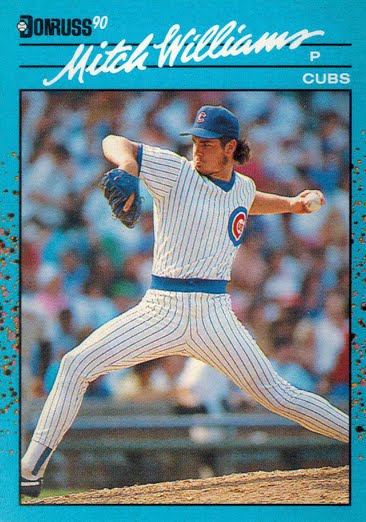
Mitch Williams.
Greg Maddux.
Moving on to the pitchers, we start with Mitch Williams.  I would say Williams is reviled in the Philly area for giving up Joe Carter's home run to end the 1993 World Series.  I think the Phillies that year had a strategy of paying more attention to their offense than to their pitching, and hoping it would work out.  It almost did.  Then there's Greg Maddux, one of the all-time greats.  Maddux was just getting underway at this point, and hadn't won any of his eventual four Cy Young awards.  In 1990 he went 15-15, which I'm sure was a letdown after his 19-12 season in 1989 and his 18-8 season in 1988.
Les Lancaster.
Mike Bielecki.
We wrap up with two more pitchers, Les Lancaster and Mike Bielecki.  Lancaster pitched for the Cubs from 1987 through 1991, then with the Tigers in 1992, and with the Cardinals in 1993 before retiring.  He had career numbers of 41-28 with a 4.05 ERA, 22 saves, and 408 strikeouts in 323 games.  Bielecki had a long-ish career in the majors, from 1984 to 1997, starting with the Pirates, then with the Cubs, Braves, Indians, and Angels.  He pitched in 347 games in the majors, with 178 starts, earning a career 70-73 record with a 4.18 ERA.

That's it for this week.  Thanks for reading!  Next week, let's take a look at the Cardinals.

Thursday, March 22, 2018

October 1988 Baseball Cards Magazine Repli-Cards: Mantle, Robinson, Winfield

I've posted on a few of my old issues of Baseball Cards magazine, which frequently came with cards you could cut out if you wanted to.  Early on, I did cut the cards out, but eventually I started to leave the issues intact.  In the October 1988 issue, the magazine included some of what they called "Repli-Cards," which in this case were "cards that never were," cards in the style of other sets, which never existed, but which would have been nice to have.
1974 Topps-style Dave Winfield Washington "Nat'l Lea." card.
Card back.
The 1974 Topps set famously jumped the gun on a possible move of the Padres to Washington, printing a number of players with the Washington "Nat'l League" designation instead of San Diego Padres.  Not all the Padres were affected, and rookie future Hall-of-Famer Dave Winfield only showed up as a Padre.  Enter Baseball Cards magazine, to provide this variant of a card collectors probably do wish existed.  The card back is the same as his actual 1974 Topps card back.
1956 Bowman-style Mickey Mantle.
Card back.
This Mickey Mantle looks like a 1958 Hires Root Beer card, which you probably know was about the same as a design that had been a prototype for a 1956 Bowman set.  In the "cards that never were" theme, this Mickey Mantle is supposed to be from that 1956 Bowman set.  The stats are his 1955 stats; for the "Singles are important, too" piece, did the magazine just make that up?
1952 Bowman-style Jackie Robinson.
Card back.
There are Bowman cards of Jackie Robinson, from 1949 and 1950.  Baseball Cards magazine wished for a 1952 Bowman of Robinson, and placed him at #1 in the set, a place which was actually occupied by Yogi Berra.  I'm not sure why they focused in 1952 in particular, but I can't blame them for wishing for more Jackie Robinson cards.
Mike Greenwell on the cover of the October 1988 issue of Baseball Cards magazine.
Mike Greenwell, who had a lot of potential at the time, was on the cover of the magazine.  The included cards are noted on the cover, as well.
The story that goes with the Repli-Cards, on sets that never were, and cards that never were.
There's a big article inside, explaining about sets and cards that the author wishes existed, like the repli-cards.

Thanks for reading!

Wednesday, March 21, 2018

1990 Topps Minis #4: Roger Clemens

Today we're at #4 in the 1990 Topps Mini League Leaders set.  The cards go in alphabetical order by team in each league, and then alphabetical by player.  So we had two Baltimore Orioles, and then on to Boston, starting with Boggs.  Card #4, then, is Roger Clemens.
Roger Clemens.
Not much needs to be said about Roger Clemens, I think, so I'll say something about his cards.  When I started collecting cards seriously in 1987, I did have some cards from prior years, including a handful from 1986.  I was just learning who the good players were, when a friend saw my 1986 Topps Roger Clemens and asked if I was willing to trade it.  I think I checked the back and saw that it wasn't a rookie card, and then I said I was fine trading it.  I don't remember what I got in exchange, but I soon regretted the trade when I found out Clemens was a big star.  I did pick up a couple more 1986 Topps Roger Clemens cards here and there later on. 
Roger Clemens card back.
Clemens earned his way into the league leaders set by being second in the AL in strikeouts in 1989 with 230.  Maybe he wasn't juicing yet, so perhaps he came by those strikeouts honestly.

Up next (on Monday): Nick Esasky, also of the Red Sox.  Thanks for reading!

Tuesday, March 20, 2018

My 1988 Topps Set Project: Cards 201-400

Today we're checking in on my 1988 Topps set project.  To remind you, I have about 1600 cards that I bought pack-by-pack back in the day.  I was 12 years old when 1988 Topps was released, was still living very near a 7-Eleven that my friends and I could walk or bike to, and we also started going to a baseball card shop (Stale Gum, on Main Street in Newark, DE), and later that year I went to my first show.  The cards I have are roughly the equivalent of having opened 3 wax boxes; I was hoping that I would have a complete set since it's about twice as many cards as is needed, but, it's turning out that I only have about 85%-90% of a set.  In these posts, I'm highlighting the cards that I have the most copies of.
Mike Marshall.
We have a new winner with Mike Marshall of the Dodgers.  In the previous post, covering cards 1-200, the most copies I had of a single card was 6.  I have 8 of this Mike Marshall.  I remember Marshall for two reasons -- he was on the Dodgers, who won the 1988 World Series, and his rookie card with Topps also features Steve Sax, who was something of a star (perhaps a minor star) at the time.  After leaving the Dodgers after the 1989 season, Marshall played briefly with the Mets, Red Sox, and Angels.
Bob Walk.
The rest of the cards I'm featuring here I have six copies of.  First up, cardblogosphere celebrity Bob Walk.  I've posted about Walk a few times before because I talk frequently about how the 1980 Phillies winning the World Series is one of my earliest memories, and Walk pitched and won the first game of the series for the Phils.  Walk was a reliable starter for the Bucs through their early 90s postseason run, and had a solid year in 1988 with a 12-10 record with a 2.71 ERA.  Walk was an All-Star for the only time in 1988; he pitched 1/3 of an inning in the All-Star game, getting Carney Lansford to ground out.
Rafael Ramirez.
Richard Dotson.

Rafael Ramirez played with Atlanta from 1980-1987, and then with Houston from 1988-1992.  He was an All-Star in 1984, and put up 1432 career hits and 484 RBI.  Richard Dotson pitched with the White Sox from 1979 through 1987, and then was with the Yankees, White Sox again, and Royals before retiring after the 1990 season.  He was also an All-Star in 1984, and led the league with 106 walks in 1983 and with 17 losses in 1986.  His career record is 111-113 with a 4.23 ERA.
Drew Hall.
Alejandro Pena.
Reliever Drew Hall pitched in the majors from 1986-1990 with the Cubs, Rangers, and Expos.  In 125 career games, he had a 9-12 record with 5 saves and a 5.21 ERA.  Alejandro Pena I do remember, probably mainly from the 1988 World Series, in which he went 1-0 pitching in two games in relief against the A's.  I might also remember him for pitching against the Pirates in the 1991 NLCS, when he was with the Braves.  Other than 1988, he was on two other championship teams, pitching in the 1981 NLCS with the Dodgers, and in the 1995 NLDS, NLCS, and World Series with the Braves.  He was a starter for a couple of years, and in 1984 led the NL in ERA with 2.48 and in shutouts with 4.
Tom Henke.
Mike Trujillo.
The Blue Jays had a number of great players in the run-up to their back-to-back World Series wins in 1992 and 1993, and Henke was their closer for many years (including the 1992 championship).  He played for Texas in 1993 and 1994, and then for the Cardinals in 1995 before retiring.  He had 311 career saves.  Mike Trujillo pitched for the Red Sox, Mariners, and Tigers between 1985 and 1989, compiling a 12-12 record with 3 saves and a 5.02 ERA in 83 big league games.

That's it for this installment.  We're making progress, and soon I'll know exactly how many 1988 Topps cards I fell short by from a complete set.  It's looking to be about 10% short, but I don't know exactly yet.  Thanks for reading!